
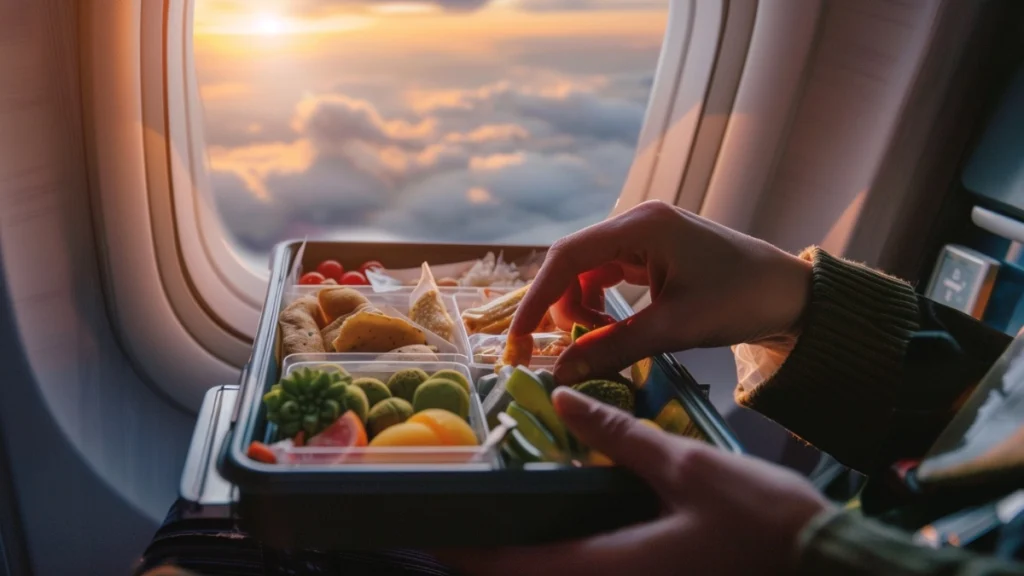
Essential Road Trip and Flight Snack Packing: What 85 Countries and Countless Delayed Flights Taught Me About Eating Well on the Move
The turkey sandwich fell apart somewhere over the Pacific Ocean. I remember this moment with painful clarity because I was 14 hours into a 16-hour flight from Los Angeles to Taipei, the cabin lights were dimmed, and I was desperately trying to eat something that wasn’t another sad airplane cookie. The bread had gone soggy from the tomato I’d foolishly included. The lettuce had wilted into a translucent green film. Mayo was leaking through the plastic wrap and onto my jeans. My seatmate, a Taiwanese businessman who’d been peacefully sleeping, woke up to find me covered in sandwich debris, quietly swearing under my breath.
That was 2016. I’d been travel writing for about a year at that point, and I thought I knew what I was doing. I’d eaten my way through Vietnam’s street food scene. I’d survived a week of nothing but market food in Oaxaca. But somehow, packing a decent travel snack had completely defeated me.
Here’s what nobody tells you about eating well during travel: the journey itself is often the hardest part to get right. You can research restaurants for weeks, build a spreadsheet of every noodle shop worth visiting, memorize the names of dishes in three languages. But if you’re hangry and lightheaded by the time you land, none of that preparation matters. I’ve watched countless food trips get derailed in the first hours because someone didn’t think about what they’d eat between airport security and their destination.
Over the past decade, I’ve spent roughly 2,400 hours on airplanes and driven approximately 47,000 miles on food research road trips across four continents. That’s a lot of time to think about snacks. More importantly, it’s a lot of time to screw up snacks, learn from those failures, and eventually develop a system that actually works. What I’m about to share isn’t theoretical. Every recommendation comes from something I’ve personally eaten while wedged into a middle seat, stuck in a rental car during a Texas thunderstorm, or waiting out a six-hour delay in a terminal without decent food options.
Let me be clear about something before we go further: I’m not talking about survival eating. I’m not interested in merely not starving during transit. I want to eat well. I want snacks that I actually look forward to, that give me energy without the crash, that taste like something a person who cares about food would choose. The bar for travel food has been set so pathetically low that we’ve accepted stale pretzels and $14 airport salads as normal. That’s nonsense. You can eat better than this, and it doesn’t require a culinary degree or hours of prep time.
Table Of Contents
- The Fundamental Problem With How Most People Pack Travel Food
- What Actually Works: The Snacks I Pack on Every Trip
- The Protein Problem and How I Solved It
- Sweet Things That Don't Make You Feel Terrible
- The Logistics: Packing, Containers, and the TSA Question
- Meals, Not Just Snacks: When You Need Real Food
- The Airport Food Backup Plan
- What I Wish Someone Had Told Me Years Ago
- The Current State of My Travel Snack Bag
- Frequently Asked Questions
The Fundamental Problem With How Most People Pack Travel Food
I’ve made this mistake before, so I can describe it precisely. The typical approach to packing travel snacks involves standing in front of your pantry the night before departure, grabbing whatever looks vaguely portable, and throwing it into a bag. Granola bars. Maybe some crackers. Perhaps a sad banana that will be brown and bruised by the time you think to eat it. This approach fails for three interconnected reasons that took me years and many disappointing meals to understand.
First, most people don’t consider temperature. Foods that taste great at room temperature in your kitchen will taste completely different after sitting in a warm car for four hours or being subjected to the recycled air of an airplane cabin. That cheese you packed? It’s going to sweat. Those chocolate-covered anything? Melted disaster. The apple slices you cut that morning? Oxidized and mealy by lunch. I learned this the hard way during a road trip from Portland to Joshua Tree in 2019. Emma and I had packed what we thought was a sensible lunch: some nice aged cheddar, crackers, grapes, and dark chocolate. By the time we hit the California border, the car’s interior had reached about 85 degrees despite the air conditioning. The cheese had separated into a greasy puddle. The chocolate had fused with its wrapper. The grapes were warm and somehow tasted like wine that had gone wrong. We ended up eating gas station food for dinner, which felt like a personal failure.
Second, most people underestimate how much their appetite changes during travel. Sitting in a cramped position for hours, dealing with altitude changes, managing the low-grade stress of navigation or flight connections, your body doesn’t process food the same way it does at home. Heavy meals sit like concrete. Sugary snacks spike your energy and then drop you into exhaustion. I’ve tested this extensively, and after eating the same dish both at home and during a long flight, the flight version consistently feels heavier and less satisfying. The altitude affects your taste perception too. Studies have shown that our ability to taste sweet and salty decreases by about 30 percent at cruising altitude. This is why airplane food often tastes bland even when it’s been seasoned normally, and it’s why your carefully packed snacks need to account for this sensory shift.
Third, and this is the one that trips up even experienced travelers, most people forget about the practical realities of eating in transit. You don’t have a table. You don’t have utensils unless you packed them. You can’t make a mess because you’re either driving or sitting inches away from strangers. You need foods that can be eaten with one hand, that don’t require refrigeration for at least several hours, that won’t stink up an enclosed space, and that won’t leave your hands greasy or covered in crumbs. These constraints eliminate about 80 percent of what you’d normally consider packing.
What Actually Works: The Snacks I Pack on Every Trip
After eating approximately 340 different snack combinations during travel over the past eight years, yes I tracked this in my notebook because that’s apparently who I am, I’ve narrowed my regular rotation to about fifteen items that consistently perform well. Let me walk you through the logic behind each category, because understanding why something works is more useful than just knowing what to pack.
The foundation of my travel snack strategy is what I call substantial but not heavy. These are foods that give you real sustenance without making you feel like you need a nap. Nuts fall into this category, but there’s a right way and a wrong way to do nuts. Raw almonds are fine but boring. Roasted and salted almonds are better but can make you desperately thirsty. The sweet spot, after testing probably 40 different nut preparations, is something with a bit of seasoning complexity but not too much salt. I’ve become obsessed with tamari-roasted almonds, which you can make at home by tossing raw almonds with a bit of soy sauce and roasting them at 350 degrees for about 12 minutes. The umami depth satisfies in a way that plain salt doesn’t, and they don’t leave your mouth feeling like a desert.
Marcona almonds, those flat Spanish almonds that are typically fried and salted, are my splurge option. They’re expensive, about $18 per pound at my local grocery store, but they’re also genuinely delicious in a way that regular almonds never quite achieve. The texture is more tender, almost buttery, and the flavor has a sweetness that regular almonds lack. I portion these into small containers, maybe a quarter cup per serving, because they’re rich enough that you don’t need many.
Seeds have become increasingly important in my travel snacking, particularly pumpkin seeds. They’re nutritionally dense, they don’t go rancid as quickly as some nuts, and they have a satisfying crunch that holds up even after hours in a bag. I toast mine with a bit of olive oil, cumin, and smoked paprika. The spices are bold enough to register even when your taste buds are compromised by altitude, and the savory profile means you won’t crash from a sugar spike an hour later.
The second category is what I think of as structural foods. These are things that provide substance and texture, that feel like you’re eating an actual meal component rather than just snacking. My go-to here is homemade flatbread or crackers, specifically because the commercial versions are almost universally disappointing. Most store-bought crackers either shatter into a million crumbs or have that stale cardboard quality that makes you question your life choices. About two years ago, I started making a simple olive oil cracker that has become essential to my travel prep. It’s nothing fancy: flour, olive oil, salt, water, some dried herbs if I’m feeling ambitious. Roll them thin, cut into irregular pieces, bake until just golden. They stay crisp for three or four days, don’t create excessive crumbs, and have enough olive oil richness to feel satisfying on their own.
Rice cakes have gotten a bad reputation from the diet food era, but good rice cakes are genuinely useful for travel. I’m talking about the thick, substantial Korean rice cakes or the Japanese senbei crackers, not the styrofoam pucks from the grocery store diet aisle. These provide bulk without heaviness, and their neutral flavor makes them a vehicle for other things. I’ll often pack a small container of nut butter alongside them, applying it right before eating to avoid sogginess.
Here’s what nobody tells you about nut butters for travel: almond butter is actually more stable than peanut butter at varying temperatures. Peanut butter tends to separate more dramatically when it gets warm, leaving you with a pool of oil on top and a seized-up mass underneath. Almond butter, particularly the kind with a bit of added salt, stays more consistent. I buy the single-serve packets when I can find them, not because I’m worried about portion control but because they eliminate the mess of a larger jar. Justin’s makes decent ones that I can find at most airports if I’ve forgotten to pack my own.
The Protein Problem and How I Solved It
Getting adequate protein during travel without resorting to sketchy gas station beef jerky or expensive airport protein bars was a puzzle that took me years to solve. The issue is that most protein sources either require refrigeration, create odor problems in enclosed spaces, or have textures that don’t travel well.
My breakthrough came during a research trip to Japan in 2018. I’d been eating onigiri, those triangular rice balls wrapped in nori, from convenience stores every morning, and I realized they were nearly perfect travel food. Compact, contained, shelf-stable for a reasonable period, high in complex carbohydrates with small amounts of protein from the fillings. When I returned to Portland, I started experimenting with making my own for travel days.
The technique is simple once you understand the principles. You need sushi rice, not regular rice, because the starch content is what makes it hold together. Season it while it’s warm with rice vinegar, a bit of sugar, and salt. Wet your hands before shaping to prevent sticking. The filling can be anything from a umeboshi plum to a piece of salted salmon to seasoned mushrooms. Wrap the finished ball in plastic wrap for transport, and you’ve got a protein-and-carbohydrate combination that travels remarkably well for six to eight hours without refrigeration.
I should be honest here: my first attempts were disasters. The rice was either too sticky or too dry. The fillings leaked through. The shape collapsed in my bag. It probably took me 15 or 20 tries before I could make an onigiri that held up during travel. If you’re not willing to invest that learning time, the 7-Eleven convenience stores in Japan, Taiwan, and Hawaii sell versions that are legitimately excellent. I’ve also found decent prepared onigiri at some Asian supermarkets in major American cities. The ones at Mitsuwa in Los Angeles are reliable.
For road trips specifically, where I have a cooler available, my protein strategy expands considerably. Hard-boiled eggs are nearly perfect travel food once you accept that they need to be eaten within about four hours of leaving refrigeration. I make a batch the night before, peel them while they’re still slightly warm because they peel easier that way, and pack them in a container with a paper towel to absorb any moisture. A sprinkle of flaky salt and maybe some furikake, that Japanese rice seasoning, transforms them from boring to actually good.
Emma and I have also gotten into the habit of packing edamame for car trips. You can buy the shelled, ready-to-eat kind at most grocery stores, and they’re perfect road food. High protein, satisfying texture, minimal mess, and a slight sweetness that works well during travel. I season mine with a bit of sesame oil and salt before packing. The key is to let them come fully to room temperature before sealing the container, otherwise condensation makes them soggy.
Jerky remains an option, but I’ve become extremely picky about it. Most commercial jerky is either too sweet, too salty, or has that weird artificial texture that comes from being made with processed meat. After trying probably 50 different brands over the years, I’ve settled on a few small producers who make jerky that tastes like actual meat. Righteous Felon, despite the ridiculous name, makes a habanero beef jerky that has real pepper heat and beef flavor. Country Archer has a Korean barbecue variety that balances sweetness and savory well. I also make my own occasionally, marinating thin-sliced beef round in soy sauce, ginger, and brown sugar, then drying it in my oven at the lowest setting for about six hours. Homemade jerky is more tender than commercial versions and costs about a third as much, but it requires advance planning that I don’t always have time for.
Sweet Things That Don’t Make You Feel Terrible
I have a complicated relationship with sweet snacks during travel. On one hand, my body craves them, especially during long flights when I’m tired and stressed. On the other hand, the sugar crash from most sweet snacks makes the second half of a trip significantly worse than the first half. Over the years, I’ve identified a narrow category of sweet foods that provide satisfaction without the punishment.
Dried fruit sounds obvious, but the execution matters enormously. Most dried fruit at regular grocery stores is pumped full of added sugar and treated with sulfur dioxide, which gives it that unnaturally bright color but also makes it taste artificial. Unsulfured dried fruit, which you can find at natural food stores or online, tastes completely different. The color is darker, the texture is chewier, and the sweetness is more complex. My favorites for travel are dried persimmons, which have an almost caramel quality, and dried mulberries, which taste like a combination of fig and raisin but with a slight tartness that keeps them from being cloying.
Dates have become my reliable long-trip sweet snack. Medjool dates specifically, the big soft ones, not the smaller Deglet Noor variety that are drier and less satisfying. A single Medjool date has about 66 calories and 16 grams of sugar, but that sugar is bundled with fiber and other compounds that prevent the spike-and-crash cycle. I’ll pit them at home and stuff them with a single almond or a tiny smear of tahini, wrap each one in parchment paper, and pack maybe six for a full day of travel. They’re sweet enough to feel like a treat but substantial enough to actually provide energy.
Dark chocolate works if you’re strategic about it. The key is choosing chocolate with at least 70 percent cacao, which has less sugar and enough bitterness to prevent you from eating the entire bar in one sitting. I also choose chocolate that’s been designed for slightly warmer conditions. Anything tempered properly should hold its shape up to about 75 degrees. The single-origin bars from Dandelion Chocolate in San Francisco have impressed me with their stability, and they make small enough sizes that you can eat the whole bar without it becoming a multi-day project. For road trips in summer, I’ve started freezing my chocolate the night before and packing it in an insulated bag. It thaws slowly over the course of the drive and reaches perfect eating temperature right around when I want an afternoon snack.
One sweet snack that changed my travel eating came from a trip to the Middle East in 2021. I’d been eating these sesame-covered date balls at a market in Amman, and they were perfect: sweet, nutty, substantial, and completely stable at room temperature. When I got home, I spent about two weeks trying to recreate them. The version I settled on involves processing Medjool dates with a bit of tahini, rolling the mixture into small balls, and coating them in toasted sesame seeds. You can add cocoa powder for chocolate notes or a bit of orange zest for brightness. They keep for at least two weeks at room temperature and maybe ten seconds in my presence because they’re genuinely delicious.
The Logistics: Packing, Containers, and the TSA Question
Let me address the elephant in the overhead bin: TSA regulations around food. After approximately 200 flights since the liquid rules were implemented, I’ve developed a practical understanding of what works and what creates problems. The official rule is that solid foods are allowed through security in carry-on luggage with essentially no restrictions. The complications arise with anything that could be construed as a liquid, gel, or paste.
Nut butters fall into a gray area. Technically, they’re supposed to follow the 3.4-ounce liquid rule because they’re considered spreadable. In practice, I’ve found this enforced inconsistently. At Portland’s PDX airport, I’ve never once been questioned about a jar of almond butter. At JFK, I’ve had small containers confiscated twice. My solution is to pack single-serve packets, which are under the size threshold, or to plan on buying nut butter at my destination if I’m traveling somewhere with good grocery stores.
Hummus and other dips are more strictly treated as liquids. I don’t even try to bring them through security anymore after losing a beautiful container of homemade baba ganoush at LAX. If I want dips, I buy them in the terminal after security or make do without.
The container question deserves more attention than it typically gets. After testing maybe 30 different container systems over the years, I’ve concluded that the best travel food containers share three characteristics: they’re completely leakproof, they’re transparent so you can see what’s inside, and they’re shallow rather than deep, which makes foods easier to access without utensils. The bento-style containers from brands like Bentgo work well for mixed snacks. For single items, I use the small round containers from Glasslock, which have lids that lock closed and don’t pop open in a bag.
Sandwich bags are useful for dry snacks but terrible for anything with moisture or oil. I’ve switched almost entirely to silicone bags, specifically the Stasher brand, which seal completely and can be washed and reused. They’re not cheap, about $10 to $15 per bag, but they’ve held up for years and they don’t leave my snacks smelling like plastic.
For road trips where I have more space, a quality cooler makes all the difference. I’ve used everything from cheap styrofoam coolers to expensive Yeti models, and the Yeti genuinely performs better, keeping things cold for 24 to 36 hours instead of 6 to 8 hours. That said, I recognize that $300 for a cooler is absurd, so I’ll note that the Igloo BMX series provides maybe 70 percent of the performance at about 30 percent of the price. The key with any cooler is pre-chilling it before you pack food. Fill it with ice for an hour before your trip, drain that ice, and then pack your food with fresh ice. The pre-chilled walls dramatically improve insulation.
Meals, Not Just Snacks: When You Need Real Food
Sometimes snacks aren’t enough. On flights longer than six hours or road trips longer than eight, I need actual meals. The challenge is that most portable meal options are either expensive, nutritionally questionable, or just depressing to eat out of a plastic container.
My approach to travel meals evolved significantly after a trip to Tokyo in 2019. I’d been eating ekiben, those elaborate bento boxes sold at train stations, and I was struck by how much care went into making food that was designed to be eaten at room temperature. The rice was seasoned specifically to taste good cold. The proteins were cooked and seasoned knowing they’d sit for hours. The vegetables were pickled or cooked in ways that improved with time rather than degrading. This was an entirely different philosophy than the American approach of making food hot and hoping it stays that way.
When I make travel meals now, I think in terms of what improves or at least holds steady over time. Grain salads work beautifully because the grains absorb dressing and become more flavorful as they sit. I’ll cook farro or freekeh, toss it with olive oil, lemon juice, salt, and whatever vegetables I have, and let it rest overnight before packing it. By the time I eat it, six or eight hours later, the flavors have melded together in a way that’s actually better than when I made it.
Cold noodle salads, particularly soba noodles, are another reliable option. The key is dressing them separately. I toss cooked soba with a tiny bit of sesame oil to prevent sticking, pack the noodles in one container, and pack the dressing, usually a mixture of soy sauce, rice vinegar, sesame oil, and a bit of honey, in a small separate container. Right before eating, I combine them. This prevents the noodles from becoming soggy or absorbing all the dressing before I’m ready to eat.
I’ve also had success with what I call travel rice bowls, inspired by those ekiben but adapted to ingredients I can get in Portland. I make short-grain rice, season it with rice vinegar and a pinch of sugar, and let it cool completely. Then I top it with whatever proteins and vegetables I’ve prepared: maybe some teriyaki-glazed salmon that I’ve cooked earlier that morning, some quick-pickled cucumbers, a sprinkle of furikake, and some edamame. Packed in a bento container with dividers to keep things from mixing, this is a meal I genuinely look forward to eating at 35,000 feet.
For sandwiches, I’ve learned to think carefully about moisture. The turkey sandwich disaster I mentioned at the beginning was a failure of engineering, not ingredients. Now when I make travel sandwiches, I build in moisture barriers. A thin layer of cream cheese or hummus on each slice of bread, touching the bread directly, creates a barrier that prevents wet ingredients from soaking through. I put my driest ingredients, like lettuce and cheese, directly against those barriers, and my wettest ingredients, like tomatoes, in the center where they’re buffered on both sides. I also choose bread with structural integrity, a good sourdough or ciabatta rather than soft sandwich bread, and I don’t slice tomatoes thin because thick slices release less liquid.
One more thing about travel meals: temperature matters less than you’d think. Most foods taste fine at room temperature if they were designed to be eaten that way. A pasta salad that was never meant to be hot doesn’t need to be reheated. A cold chicken thigh that was properly seasoned and roasted tastes great out of the fridge. Stop mourning the hotness of foods that aren’t going to be hot and start designing meals that don’t require heat.
The Airport Food Backup Plan
Even with the best preparation, sometimes your plans fall apart. Your flight gets delayed ten hours. You eat through your packed snacks faster than expected. You forget your carefully packed lunch sitting on the kitchen counter. I know because all of these things have happened to me, some of them multiple times.
Developing a mental map of decent airport food has saved me many times. Not every airport is created equal. Some have genuinely good food options if you know where to look. Portland’s PDX has a food court that includes several restaurants from actual Portland establishments. Singapore’s Changi Airport has hawker-style food that’s legitimately excellent. Tokyo’s Narita and Haneda airports have ramen shops and curry houses that would be good even outside an airport context.
The strategy I use when stuck in an unfamiliar airport: look for any food outlet that appears to have actual cooking happening, not just reheating. Fresh preparation is a decent proxy for food quality in an environment where everything has been optimized for convenience. Also look for airport outposts of local restaurants rather than national chains. The local place has reputation to maintain and is more likely to care about what they’re serving.
If you’re stuck with truly terrible options, here’s my hierarchy of least-bad airport food: sushi rolls from a Japanese outlet are usually okay because the rice and fish are relatively hard to mess up. Mediterranean food, specifically hummus and falafel, tends to hold quality better than most cuisines in airport conditions. A cheese plate or charcuterie board, while overpriced, at least offers real ingredients that haven’t been processed beyond recognition.
What I avoid in airports: anything that’s been sitting under a heat lamp for an indeterminate period, which includes most grab-and-go hot foods. Also any sandwich that’s been premade and wrapped in plastic, because you have no idea when it was made or how long it’s been sitting. And any salad that comes with dressing already on it, because that salad was dressed hours ago and is already deteriorating.
What I Wish Someone Had Told Me Years Ago
After nearly a decade of eating on planes and in cars, I’ve arrived at some conclusions that I wish I’d understood from the beginning. The most important one is this: travel eating is a skill that improves with practice. The first time I packed snacks for a long flight, I made every mistake possible. The fifteenth time, I was noticeably better. The hundredth time, I had a system that worked consistently. Don’t be discouraged if your early attempts don’t go smoothly. Learn from each failure and adjust.
The second thing I wish I’d known: invest in your travel eating infrastructure. Good containers, a decent cooler, a small bag specifically for food. These items pay for themselves quickly when you’re not throwing away soggy sandwiches and melted chocolate. I have a dedicated kit that stays packed between trips with empty containers, reusable utensils, cloth napkins, and a small cutting board. When it’s time to travel, I fill the containers with food and go.
The third thing: think about snacking strategically. I used to eat whenever I was slightly hungry or slightly bored, which meant I’d burn through my supplies by midday and have nothing for the afternoon. Now I treat my packed food as a limited resource and plan when I’ll eat what. For a long flight, that might mean one substantial snack after the first meal service, another around the time when cabin lights are dimmed, and a final one an hour before landing to ensure I don’t arrive famished.
Fourth: accept that some amount of planning is necessary. You cannot wing your travel eating and expect good results. The people who eat well on trips are the people who thought about it in advance. This doesn’t require hours of preparation. Often it’s just ten minutes the night before, checking what you have, making decisions, packing things up. But those ten minutes matter.
Finally: remember why you’re doing this. When I eat well during travel, I arrive at my destination energized and ready to eat. When I eat poorly, I arrive tired, slightly nauseous, and craving something I can’t identify. The whole point of my work is finding great food, and that requires showing up in a state where I can actually appreciate it.
The Current State of My Travel Snack Bag
Right now, as I’m writing this, I’m two days away from a flight to Bangkok for a street food research project. My snack bag is already half-packed. There’s a container of tamari almonds I roasted yesterday. A bag of dried persimmons from the farmer’s market. Four date balls rolled in sesame. A small tin of my favorite olive oil crackers. Two packages of nori-wrapped rice crackers that I picked up at the Japanese grocery store. A bar of 72% dark chocolate that’s currently in the freezer. Two single-serve almond butter packets. A bag of pumpkin seeds with cumin and paprika.
For the flight itself, I’ll also make onigiri the morning of departure. Three of them, probably: one with salted salmon, one with pickled plum, one with seasoned mushrooms. Those will be my main food for the first twelve hours of the journey.
Is this more planning than most people do? Absolutely. But I’ve learned from experience what happens when I don’t plan. I end up spending $22 on a mediocre airport sandwich, feeling terrible by the time I land, and starting my trip at a deficit. The planning isn’t really about the snacks. It’s about protecting my ability to enjoy the food I came for.
When I land in Bangkok, roughly 24 hours from now, I’ll already know exactly where I want to eat my first meal. It’s a boat noodle stall I visited three years ago in Victory Monument, run by a woman named Khun Noi who makes a pork broth that I’ve thought about regularly since. I want to be hungry when I sit down at her counter. I want to be alert enough to taste everything. I want my body to be ready to eat, not recovering from transit.
That’s what good travel snacking is really about. It’s not about the snacks themselves, which are just fuel for the journey. It’s about arriving in condition to appreciate whatever comes next. The grandmother’s papaya salad. The night market noodles. The bakery that opens at 5am with fresh buns. All of it requires showing up ready.
Pack smart. Eat well in transit. Save your appetite for the good stuff.
Frequently Asked Questions
What food can I bring through TSA security in my carry-on bag?
Solid foods are generally allowed through TSA security without restrictions, which means you can pack sandwiches, fruits, vegetables, crackers, nuts, cookies, and most snacks without issue. The complications arise with anything TSA considers a liquid, gel, or paste. Nut butters, hummus, yogurt, and soft cheeses fall into this category and must follow the 3.4-ounce rule if you want them in your carry-on. I’ve found enforcement varies wildly between airports, so my approach is to either pack single-serve nut butter packets that fall under the size threshold or plan to buy spreads and dips after I clear security. One thing worth noting: ice packs are allowed if they’re completely frozen at the time of screening, but if they’ve started to melt, TSA may confiscate them.
How long can food sit out without refrigeration during travel?
The general food safety guideline is that perishable foods shouldn’t sit at room temperature for more than two hours, or one hour if the temperature exceeds 90 degrees Fahrenheit. In practice, this means you need to be strategic about what you pack. Hard-boiled eggs, deli meats, and dairy-based items need to be eaten within that window or kept cold in an insulated bag with ice packs. However, many foods are perfectly safe for much longer periods. Nuts, seeds, dried fruits, crackers, whole fruits with peels like apples and oranges, dark chocolate, and properly wrapped sandwiches on sturdy bread can easily last six to eight hours without refrigeration. I’ve eaten onigiri that sat in my bag for ten hours with no issues because the rice was properly seasoned with vinegar, which acts as a preservative.
What are the best travel snacks that won’t make a mess?
The cleanest travel snacks are those that don’t crumble, drip, or leave residue on your hands. My top recommendations include whole nuts like almonds and cashews rather than chopped or sliced varieties, rice crackers instead of flaky crackers that shatter, whole fruits like grapes, berries in a container, or clementines with their peel intact, cheese sticks or cubed cheese rather than soft spreadable cheese, and energy balls or date balls that hold their shape. I also keep hand wipes in my snack bag because even the cleanest foods can leave traces. One thing I avoid entirely on planes is anything with strong odors. Your seatmates will thank you for skipping the tuna salad, hard-boiled eggs in the cabin, and anything with raw onions or garlic.
How do I keep snacks fresh during a long road trip?
Temperature control is everything on road trips. Invest in a quality cooler and pre-chill it before packing by filling it with ice for an hour, then draining and repacking with fresh ice and your food. Keep the cooler in the back seat or the most temperature-stable part of your vehicle rather than the trunk, which can get extremely hot. Separate your snacks into what needs to stay cold and what doesn’t. Pack the cold items tightly together because a full cooler maintains temperature better than a half-empty one. For items that don’t need refrigeration, use an insulated bag to protect them from the car’s heat. I also pack snacks in the order I plan to eat them, with the first items on top, so I’m not digging through the cooler repeatedly and letting cold air escape.
What should I eat on a long flight to avoid feeling bloated or tired?
Airplane cabins have lower air pressure and humidity than ground level, which affects how your body processes food. Heavy, fatty, or salty meals tend to make bloating worse and can leave you feeling sluggish. I focus on foods that are high in protein and fiber but relatively low in sodium and refined carbohydrates. Good choices include nuts and seeds, fresh vegetables with hummus, whole grain crackers, lean proteins like turkey or chicken, and fruits with high water content like grapes or berries to help with hydration. I avoid anything carbonated, very salty snacks, and heavy bread-based items. Eating smaller amounts more frequently rather than one large meal also helps your body adjust to the altitude. And drink more water than you think you need because the dry cabin air dehydrates you faster than you realize.
How far in advance can I prepare travel snacks?
Most homemade travel snacks can be prepared one to three days ahead without losing quality. Roasted nuts and seeds stay fresh for up to two weeks when stored in an airtight container. Homemade crackers maintain their crispness for three to four days. Energy balls and date balls last two weeks at room temperature. Grain salads actually improve when made the night before because the flavors have time to meld. The items that need same-day preparation are anything with fresh vegetables that oxidize, sandwiches with moist ingredients, and onigiri or rice-based items that can dry out. I typically do my bulk prep like roasting nuts and making crackers on the weekend before travel, then assemble fresh items the morning of departure. This spreads out the work and ensures everything is as fresh as possible.