
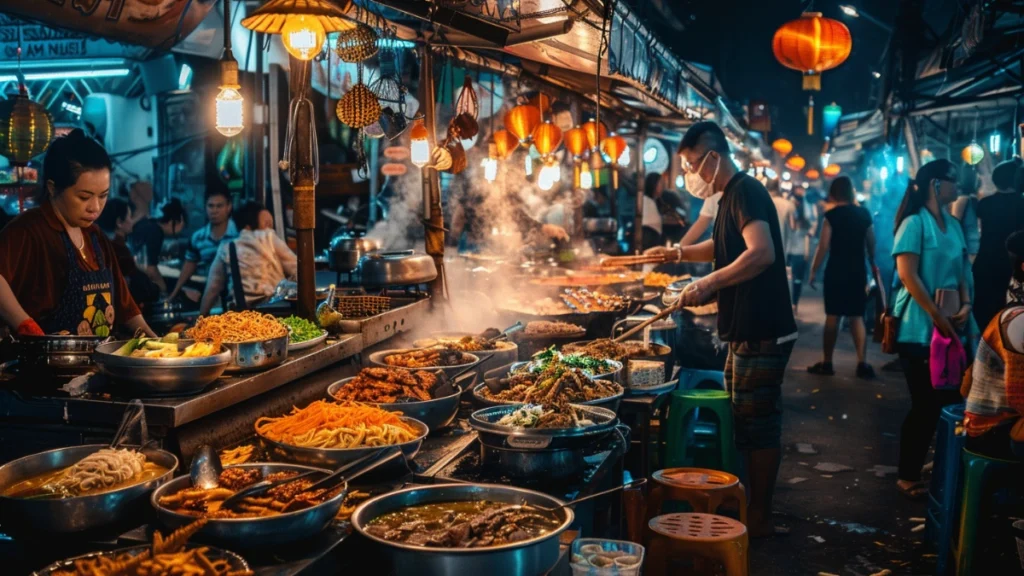
Global Street Food Culture and Must-Try Dishes: What I’ve Learned Eating My Way Through 85 Countries
The smoke hit me before I even saw the cart. It was 5:47am in Oaxaca City, Mexico, and I’d been wandering the empty streets near Mercado 20 de Noviembre searching for the tlayuda vendor my hotel clerk had described in broken English and enthusiastic hand gestures. “Very big, like pizza, but… crispy, crunchy,” she’d said, making a satisfying snapping motion with her fingers. I found Doña Carmen hunched over a wood-fired comal, flipping a disc of masa the size of a dinner plate. She barely looked up when I approached. The tlayuda she handed me twelve minutes later, slathered with black bean paste, quesillo cheese, and chorizo that still glistened with rendered fat, remains one of the best things I’ve ever put in my mouth. It cost 45 pesos, roughly $2.50 at the time.
I share this because it captures everything I’ve come to understand about street food after a decade of obsessive eating across six continents. The best meals rarely come from places with menus or air conditioning. They come from people like Doña Carmen, who’ve been making the same dish the same way for thirty years, who know exactly when the masa has hit the right texture, who couldn’t care less whether you’re a tourist or a local as long as you show up hungry.
Street food isn’t just cheap eats. It’s the backbone of how most of the world actually feeds itself. It’s cultural preservation in edible form. And if you know how to navigate it, it’s the fastest way to understand a place you’ve never been.
Table Of Contents
- Why Street Food Matters More Than Restaurant Food
- The Art of Finding the Good Stuff
- Understanding Regional Variations: The Same Dish Isn't the Same Dish
- The Technical Stuff: What Makes Street Food Great
- Navigating Safety Without Being Paranoid
- The Geography of Street Food: Regional Deep Dives
- The Economics of Eating Well on the Street
- What I Didn't Like: Honest Criticisms of Street Food Culture
- What I Loved: The Reasons I Keep Coming Back
- Final Thoughts and Practical Advice
- Frequently Asked Questions
- Is street food safe to eat when traveling abroad?
- What are the best countries for street food culture?
- How do I find authentic street food vendors and avoid tourist traps?
- How much should I budget for street food meals while traveling?
- What are the most popular street foods around the world worth trying?
- What should I know before trying street food for the first time?
- Learn About More Experiences
Why Street Food Matters More Than Restaurant Food
I need to be honest about something before we go further. I went to culinary school. I spent three years working the line at a restaurant where a single entree cost more than most families spend on weekly groceries. And yet, when I think about the meals that fundamentally changed how I understand food, almost none of them happened in proper restaurants.
The version of dan dan noodles I grew up eating in San Francisco’s Chinatown was a pale imitation. I didn’t know this until I was twelve years old, sitting on a plastic stool in Taipei, watching my grandmother slurp noodles from a cart vendor named Mr. Liu who’d been stationed on that same corner for forty years. His noodles had a chili oil that didn’t just bring heat but carried this deep, nutty complexity that I later learned came from roasting Sichuan peppercorns and sesame seeds together before infusing them into the oil. The preserved vegetables added a funk that the American versions always seemed to sanitize away. That bowl cost about 50 Taiwan dollars, less than two bucks, and it rewired my understanding of what food could be.
Street food represents an unbroken chain of culinary knowledge that restaurants often interrupt. When you eat from a vendor who learned from their mother who learned from their grandmother, you’re accessing a version of a dish that hasn’t been filtered through culinary school technique or adapted for perceived Western palates. This isn’t me being precious about authenticity, which is a word I’ve learned to use carefully. It’s me acknowledging that there’s something valuable about eating food made by someone whose entire professional identity is built around perfecting one or two dishes rather than executing a menu of forty.
The economics matter too. Street vendors operate with almost no overhead. No rent to speak of, minimal staff, basic equipment. This means they can spend more on ingredients relative to what they charge. The taco al pastor I ate at a street stand in Mexico City’s Condesa neighborhood used pork shoulder that had been marinating for eighteen hours. The vendor, a guy named Roberto who’d inherited the cart from his father, told me he spent about 35% of his revenue on ingredients. Compare that to most restaurants, where food cost hovers around 28-32% and that percentage includes the cheap stuff like rice and garnishes.
The Art of Finding the Good Stuff
Here’s what nobody tells you about eating street food well: it requires research. Not the kind of research where you google “best street food in Bangkok” and click the first TripAdvisor link. Real research.
Before I visit any city, I spend between ten and fifteen hours preparing. I start with local food blogs, often translated through Google because the best information lives in local languages. I join Facebook groups for expats and food enthusiasts in that specific city. I study Google Maps reviews, but here’s the key: I read the reviews written in the local language and translate them, because those reviewers are usually locals who have actual comparison points. I message people who’ve posted food photos that got thousands of likes on Instagram and ask them for their top three recommendations.
By the time I land in a new city, I’ve got a map with fifty or more pins and a prioritized hit list of about twenty spots I absolutely have to try. This might sound excessive, but I’ve learned the hard way what happens when you wing it.
In 2017, I spent an entire day eating at a “famous” market in Bangkok that turned out to cater almost entirely to tourists. Every vendor had laminated English menus with photos. The pad thai was gummy and oversweetened. The som tam lacked the fermented fish funk that makes the dish what it is. I’d followed a hotel concierge’s recommendation, and I should have known better. Hotel concierges, in my experience, recommend places that won’t generate complaints from tourists with sensitive stomachs, not places that actually serve the best food.
The pattern recognition matters. When you’re researching, look for vendors or stalls that get mentioned repeatedly across multiple sources. Look for places where the recommendations come with specific details: “get there before 7am because they sell out” or “ask for the special chili sauce they keep behind the counter.” These kinds of details signal that the recommender actually went and paid attention, not just that they’re repeating something they read elsewhere.
Understanding Regional Variations: The Same Dish Isn’t the Same Dish
After eating banh mi in Vietnam across eight different cities, I can tell you that a banh mi in Hanoi and a banh mi in Ho Chi Minh City are almost different sandwiches. The northern version tends toward subtlety: a more delicate pate, lighter pickles, less aggressive chili. The southern version goes bigger on everything. The bread is crustier. The fillings are more generous. There’s often a sweeter element from a mayonnaise that’s touched with condensed milk.
This regional variation exists for almost every iconic street food dish, and understanding it will fundamentally change how you eat.
I spent a month in 2019 eating tacos al pastor at every opportunity across five Mexican cities. The Mexico City version, which most people consider canonical, features pork sliced from a vertical spit, topped with pineapple, on small corn tortillas. But in Tijuana, I found versions where the meat was crisped almost to the point of charring on the edges, giving each bite a textural complexity the Mexico City versions lacked. In Oaxaca, some vendors added a layer of quesillo cheese that melted into the tortilla. In Puebla, the spice profile shifted toward more complex dried chilies rather than just achiote.
None of these variations are wrong. They’re adaptations to local preferences, local ingredients, and local culinary traditions. When you understand this, you stop asking “where can I find the authentic version” and start asking “what’s the version that reflects this specific place.”
I’ve made this mistake before. I went to Naples expecting to find the “original” pizza, as if there were some Platonic ideal of pizza that all other pizzas were merely imitating. What I found instead were dozens of pizzerias, each making slightly different choices about char level, sauce consistency, mozzarella moisture content, and crust thickness. Da Michele, the famous spot that Anthony Bourdain visited, makes an excellent pizza with a wet center that requires eating with a fork. But three streets away, a place called Starita makes a pizza that’s slightly more structured, slightly less soupy, and honestly, for my personal preferences, more satisfying to eat. Neither is more authentic. They’re just different expressions of the same tradition.
The Technical Stuff: What Makes Street Food Great
Let me geek out for a minute about what actually makes street food work at a technical level.
Most street food vendors are working with extremely high heat. The woks at Thai street stalls operate at temperatures that would set off the fire suppression system in a Western restaurant. This heat is essential for wok hei, that smoky, slightly charred quality that makes a good pad thai or char kway teow taste like itself. You cannot replicate this at home on a standard residential burner. I’ve tried. The physics don’t work.
The vessels matter too. The clay pots used for Mexican barbacoa trap moisture and distribute heat differently than any metal pan. The tandoor ovens used across South Asia and the Middle East can reach temperatures above 900 degrees Fahrenheit, creating the characteristic char and puff on naan and other breads in seconds. The flat comal used for tortillas has been engineered through centuries of iteration to provide exactly the right amount of contact heat.
Then there’s the seasoning of the equipment. A wok that’s been used daily for twenty years has built up layers of polymerized oil that create a natural non-stick surface and add flavor through what food scientists call Maillard reactions. A new wok, no matter how expensive, cannot replicate this. When street vendors pass their equipment down through generations, they’re passing down flavor.
I talked to a ramen vendor in Osaka named Tanaka-san who’d been using the same pot for his tonkotsu broth for over thirty years. He never washed it with soap, just rinsed it with water. He believed, and I think he’s right, that the pot itself had absorbed decades of pork fat and bone essence that contributed to his broth’s depth. Whether this is scientifically accurate or not, his ramen was the best I’ve had in Japan across ten trips, so I’m not about to argue with his methodology.
Navigating Safety Without Being Paranoid
I’ve eaten street food in over eighty countries. I have been sick exactly four times that I can attribute to street food specifically. Three of those times were my own fault.
The fear that many Western travelers have about street food safety is largely overblown, but it’s not entirely irrational. The key is understanding what to look for and what to avoid.
High turnover is your friend. If a vendor is selling food fast, their ingredients aren’t sitting around at dangerous temperatures. The cart with a line fifteen people deep is almost always safer than the cart with no line, even if the empty cart looks cleaner. That line means fresh product moving through quickly.
Watch how the vendor handles money. In places where the same person handles cash and food, look for whether they’re using gloves, tongs, or at minimum, washing or sanitizing their hands between transactions. This isn’t universal, but it’s a good indicator of general hygiene consciousness.
Meat is riskier than vegetables, but not in the way most people think. It’s not about the meat being undercooked, since most street vendors are cooking over extremely high heat. It’s about how long the raw meat has been sitting and at what temperature. If you can see raw meat sweating in the sun, skip that vendor. If the raw product is kept in a cooler or in a shaded area and gets cooked to order, you’re probably fine.
Shellfish on the street is the one thing I generally avoid unless I’m in a place with an extremely robust seafood infrastructure. Tokyo, yes. Lima, yes. Random inland city without a major fish market, probably not. The one serious food poisoning incident I had came from shrimp tacos in a Mexican beach town where I should have known better. The shrimp had that slight ammonia smell that indicates breakdown, and I ate them anyway because I didn’t want to be rude. Don’t be me.
Water and ice are the invisible variables. In places where tap water isn’t safe to drink, assume the ice is made from the same water. This matters more for drinks than for food, but it’s worth asking about. Many higher-end street vendors in cities with known water issues now use purified or bottled water for their ice. Some will tell you if you ask, but you have to ask.
The Geography of Street Food: Regional Deep Dives
Let me take you through some of the places where I’ve spent the most time eating, with specific recommendations for what to look for and what to try.
Southeast Asia remains, in my experience, the global capital of street food culture. The infrastructure for eating on the street is more developed here than anywhere else I’ve traveled. In Bangkok alone, there are an estimated 300,000 street vendors, a number that has decreased due to government crackdowns but still represents an incredible density of options.
The Thai government’s periodic attempts to clear street vendors from certain areas always strike me as tragic. Some of the best food I’ve ever eaten was from vendors who’ve since been displaced. There was a woman named Khun Noi who made khao man gai, the Thai version of chicken rice, from a cart near Pratunam. Her poached chicken had this perfect texture, somewhere between silky and bouncy, and she served it with a ginger sauce that I can still taste when I close my eyes. Her cart was removed in 2017, and I’ve never been able to find where she went.
In Vietnam, the morning soup culture defines the street food experience. Pho in the north, hu tieu in the south, bun bo Hue in the central region. Each of these soups represents a completely different approach to broth, noodles, and accompaniments. I’ve made the mistake of treating them as interchangeable. They’re not. The pho you eat in Hanoi, with its clearer broth and more restrained garnishes, is not trying to be the same thing as the pho you eat in Saigon, with its sweeter broth and explosion of herbs and sprouts. Understanding this prevents the disappointment that comes from expecting one thing and getting another.
Malaysia and Singapore share much of their street food heritage, but the way they’ve organized it differs dramatically. Singapore’s hawker centers are government-organized food courts where dozens of vendors operate under one roof. This makes eating more convenient but can feel a bit sanitized compared to the chaos of Malaysian street eating. The food quality in Singapore’s better hawker centers, places like Maxwell Food Centre or Old Airport Road, is genuinely excellent. But I’ve had more transcendent experiences in Malaysia, eating at ramshackle stalls in Penang where the vendors seemed to be operating on pure instinct rather than following any organized system.
The char kway teow at a stall called Sisters Char Kway Teow in Penang took my understanding of the dish to another level. The wok hei was so intense that the noodles had visible char marks, but nothing tasted burnt. The cockles they added were plump and just barely cooked through, still oceanic in flavor. The whole plate cost about 8 Malaysian ringgit, around $1.80 at the time. I went back four times during a single week.
Mexico is the other major pole of my street food world. The taco ecosystem alone could occupy a lifetime of study. Breakfast tacos in Mexico City, featuring ingredients like chicharron in salsa verde or huevos con nopales, are their own category. The taco de canasta, sold from baskets by vendors on bicycles, represents a completely different approach: soft, steamed tacos with fillings like potato, beans, or mole, sold for about 5 pesos each, roughly 25 cents. Then there are the nighttime tacos, the suadero and longaniza and al pastor from carts that set up after dark and operate until 2 or 3 in the morning.
I’ve made the mistake of thinking I understood Mexican street food after spending time only in Mexico City. Then I went to Oaxaca and discovered tlayudas and tetelas and memelas. Then I went to the Yucatan and found cochinita pibil and papadzules. Each region has its own logic, its own base starches, its own protein traditions, its own chile profile. There is no singular Mexican street food culture. There are dozens, maybe hundreds, and they share connections but maintain distinct identities.
The Middle East and Mediterranean regions offer a different kind of street food experience, one more centered on bread and grilled meats. The street food in Istanbul still astonishes me after six visits. The simit vendors who appear at every corner, selling those sesame-crusted bread rings that taste completely different when fresh versus even an hour old. The balik ekmek, fish sandwiches sold from boats bobbing at the Galata Bridge, which are either brilliant or terrible depending on which boat you choose. The kokoreç, grilled lamb intestines served in bread, which I’ll admit took me three tries before I started craving it.
In Lebanon, I’ve had some of the best street food experiences of my life, though the definition of street food blurs here. The manousheh vendors in Beirut, selling flatbreads topped with za’atar or cheese or both, kept me fed for entire days at a cost of about 3,000 Lebanese pounds per piece when I last visited, though I’m aware the currency situation has changed dramatically since. The shawarma in Beirut’s Hamra district, particularly from a place called Barbar, represented chicken shawarma at its absolute peak: crispy edges, tender interior, a garlic sauce that was aggressively pungent in the best way.
Japan offers a more restrained street food culture, one that emerges primarily at festivals and in specific zones like the yakitori alleys under Tokyo’s train tracks. The year-round street food options are fewer than in Southeast Asia, but what exists is executed with that Japanese precision. The takoyaki stands in Osaka deliver octopus balls with crisp exteriors and molten, almost custard-like interiors. The yaki-imo vendors who appear in winter, selling roasted sweet potatoes from carts, offer a simple pleasure that feels perfectly suited to cold weather eating.
The Economics of Eating Well on the Street
I’ve kept meticulous records of my food spending across different cities. Here’s what I’ve learned about eating exceptionally well without spending much money.
In Bangkok, you can eat three satisfying street food meals for about 300 Thai baht total, which works out to around $8.50. This includes a bowl of boat noodles in the morning for 25-30 baht, a plate of khao man gai for lunch at 50-60 baht, and a proper som tam and grilled chicken dinner for under 150 baht. You won’t be hungry. The food will be excellent.
In Mexico City, similar quality eating costs a bit more but remains remarkably affordable. A good breakfast of tacos de canasta might run 50 pesos. A torta for lunch at a market stall, 70-80 pesos. A sit-down taco dinner at one of the famous stands, maybe 150 pesos if you really eat. Total: under 300 pesos, roughly $17 at current exchange rates.
Tokyo is expensive by street food standards, but relative to restaurant prices it’s a bargain. You can have an excellent bowl of ramen for 900-1200 yen. A rice bowl lunch for 500-700 yen. Yakitori under the tracks for maybe 1500-2000 yen if you eat well. Total: around 3500 yen, about $23, which feels like a lot until you remember that a single restaurant dinner in Tokyo can easily exceed 10,000 yen.
The pattern holds almost everywhere. Street food represents the best value in any food culture because the overhead is minimal and the specialization is intense. You’re paying for ingredients and skill, not rent and d cor.
What I Didn’t Like: Honest Criticisms of Street Food Culture
This wouldn’t be honest if I didn’t talk about what frustrates me about street food eating.
The sustainability questions are real. The amount of single-use plastic generated by street food culture across Asia is staggering. Styrofoam containers, plastic bags, disposable chopsticks. I’ve struggled with this. I carry my own container sometimes, but many vendors won’t use it, either because of health code concerns or simply because it disrupts their workflow. The environmental footprint of eating on the street, especially in countries without robust recycling infrastructure, bothers me, and I don’t have a good solution.
The working conditions for vendors are often brutal. I’ve watched people working fourteen-hour shifts over hot grills in equatorial heat. The romanticization of street food sometimes obscures the physical toll it takes on the people making it. Many vendors I’ve talked to hope their children won’t follow them into the profession. This isn’t the nostalgic multi-generational tradition that food writing often portrays. It’s hard work with thin margins.
Quality inconsistency can be maddening. I’ve returned to favorite vendors and found the food dramatically different because a key ingredient wasn’t available, or the vendor was tired, or their supplier had changed. Restaurant food offers more consistency. Street food is variable in ways that can be frustrating when you’ve traveled specifically to eat somewhere.
The experience is also not universally accessible. Many street food environments involve standing while eating, sitting on low stools, navigating narrow alleys, dealing with smoke and heat. For people with mobility issues or certain health conditions, the physical demands of street food eating can be prohibitive. I’ve rarely seen food writing acknowledge this.
What I Loved: The Reasons I Keep Coming Back
Despite all of this, I keep chasing street food because the highs are higher than anywhere else.
The connection to place is irreplaceable. When I eat at a street stall, I’m eating in public, surrounded by the sounds and smells and chaos of actual life in that city. The meal includes the motorcycle traffic, the conversations at the next table, the vendor calling out orders, the dogs wandering between stalls hoping for scraps. This context becomes part of the flavor in ways that restaurant dining, which carefully controls environment, simply cannot replicate.
The interactions with vendors have given me some of my most meaningful travel experiences. My broken Mandarin has led to conversations with Taiwanese vendors about their families, their recipes, their lives. The woman who sold me khao soi in Chiang Mai insisted on teaching me how she made her curry paste, even though neither of us spoke the other’s language fluently. These connections happen because street food culture is inherently social in a way that restaurant culture often isn’t.
The technical excellence at the top end of street food rivals or exceeds what I’ve seen in Michelin-starred kitchens. The difference is that street vendors are achieving this excellence through repetition and instinct rather than through formal training. Watching a great street cook work is watching mastery that was earned through ten thousand hours of doing the same thing, not through culinary school theory.
And the cost to quality ratio simply cannot be matched. The $3 bowl of noodles in Hanoi that I think about regularly was better, by any honest measure, than the $45 pasta dish I ate in Rome last year. This isn’t about street food being good “for the price.” It’s about street food often being objectively better.
Final Thoughts and Practical Advice
If you’re just starting to explore street food, here’s what I’d tell you.
Do your research, but leave room for discovery. The best finds sometimes come from wandering. The place with the longest line of locals is almost always worth waiting in, even if it wasn’t on your list.
Learn a few key phrases in the local language. “This is delicious” and “what do you recommend” will open doors. People want to feed you well, and showing effort breaks down barriers.
Carry cash in appropriate denominations. Nothing kills the flow of street food eating like needing to break a large bill. In Thailand, I keep a pocket full of 20 and 50 baht notes. In Mexico, 20 and 50 peso coins. The transaction should take seconds.
Eat early. Many of the best street vendors sell out. The pho place I loved in Hanoi was done by 9am. The tlayuda cart in Oaxaca stopped serving by 8am. Morning people have a massive advantage in street food culture.
Be willing to fail. Some meals will disappoint. Some vendors will be having an off day. Some dishes simply won’t suit your palate. This is fine. The hit rate on excellent experiences, if you do your research, will be high enough to justify the occasional miss.
And finally, remember that the people making this food are people. They have good days and bad days. They have families to support and bodies that ache from standing over hot equipment. They deserve your courtesy and your appreciation. A genuine thank you, a moment of eye contact, a recognition that they’ve fed you something special, costs nothing and means something.
I think about Doña Carmen sometimes, the woman from that Oaxacan morning that opened this piece. I wonder if she’s still there at 5:47am, flipping tlayudas over wood fire, barely looking up when hungry strangers approach. I’d like to think she is. The world is better for her presence in it, and for the presence of thousands of vendors like her, keeping culinary traditions alive through the simple act of feeding people well.
The next time you travel, skip the hotel restaurant. Walk past the place with the English menu and the photos of the food. Find the cart with the line of locals and the smoke rising and the cook who’s been doing this for thirty years. Order whatever they’re selling. It might be the best meal of your trip. It might change how you think about food entirely. At minimum, it will be real, which is more than a lot of fancy restaurants can promise.
That’s what street food offers at its best: reality. No pretense, no performance, just people making food the way they know how, and other people eating it. There’s something beautiful in that simplicity, and after a decade of searching it out across the world, I still haven’t gotten tired of chasing it.
Frequently Asked Questions
Is street food safe to eat when traveling abroad?
In my experience eating street food across 85 countries, I’ve been sick only four times, and three of those were my own fault for ignoring obvious warning signs. The key is knowing what to look for. High turnover is your best indicator of safety because it means ingredients aren’t sitting at dangerous temperatures. A cart with fifteen people in line is almost always safer than an empty one, even if the empty cart looks cleaner. Watch how vendors handle money versus food, look for raw ingredients stored in coolers or shaded areas rather than sweating in direct sunlight, and trust your nose. If something smells off, particularly shellfish or meat with an ammonia edge, walk away. The fear most Western travelers have about street food is largely overblown, but it’s not irrational. Common sense and observation will protect you in most situations.
What are the best countries for street food culture?
Thailand, Vietnam, Mexico, and Malaysia consistently rank among my favorites for the depth and accessibility of their street food scenes. Bangkok alone has an estimated 300,000 street vendors, and you can eat three exceptional meals there for under $9 total. Vietnam’s morning soup culture, from pho in the north to hu tieu in the south, represents some of the most refined street cooking I’ve encountered anywhere. Mexico offers incredible regional diversity, where the tacos in Mexico City taste nothing like the tacos in Oaxaca or the Yucatan. Singapore deserves mention for its organized hawker centers where government regulation has preserved quality while making the experience more accessible. Japan, while more limited in year-round street food options, delivers exceptional precision at festival stalls and in places like Osaka’s takoyaki stands. Each country offers something different, and the “best” really depends on what kind of eating experience you’re after.
How do I find authentic street food vendors and avoid tourist traps?
Research is everything. Before I visit any city, I spend ten to fifteen hours preparing. I read local food blogs translated through Google, join Facebook groups for expats and food enthusiasts, and study Google Maps reviews written in the local language since local reviewers have actual comparison points. I look for patterns across multiple sources, specifically vendors that get mentioned repeatedly with specific details like “arrive before 7am because they sell out” or “ask for the special sauce behind the counter.” These details signal that the recommender actually visited and paid attention. Avoid hotel concierge recommendations since they typically suggest places that won’t generate tourist complaints rather than places with the best food. On the ground, follow the locals. A line of neighborhood regulars waiting at a cart at 6am tells you everything you need to know. English menus with photos are usually a warning sign, not a convenience.
How much should I budget for street food meals while traveling?
Street food offers the best value in any food culture because overhead is minimal and specialization is intense. In Bangkok, expect to spend 100 to 150 Thai baht per meal, roughly $3 to $4.50, for dishes like pad thai, khao man gai, or boat noodles. Mexico City runs slightly higher at 80 to 150 pesos per meal, around $4.50 to $8.50, depending on what you’re eating and where. Tokyo is expensive by street food standards but still a bargain compared to restaurants, with ramen running 900 to 1200 yen and rice bowls around 500 to 700 yen, putting a full day of eating at roughly $23. I’ve kept detailed records across dozens of cities, and the pattern holds almost everywhere. You’re paying for ingredients and decades of accumulated skill, not rent and interior design. A $3 bowl of noodles from a Hanoi street vendor regularly outperforms $45 pasta dishes I’ve eaten in fancy restaurants.
What are the most popular street foods around the world worth trying?
The dishes that have stuck with me most aren’t always the famous ones, but certain street foods have earned their reputations. Pad thai from a proper Bangkok street wok, with visible wok hei char and the right balance of tamarind and palm sugar, bears almost no resemblance to the gummy versions served elsewhere. Tacos al pastor in Mexico City, sliced directly from the trompo with a bit of caramelized pineapple, represent pork perfection for around 15 pesos each. Banh mi in Vietnam, whether you prefer the subtler northern style or the more aggressive southern version, offers one of the world’s great sandwiches for under $2. Char kway teow in Penang, Malaysia, cooked over such high heat that the noodles develop visible char marks without tasting burnt, changed my understanding of what noodles could be. Shawarma in Beirut, particularly the chicken version with that aggressively pungent garlic sauce, sits in a different category than any shawarma I’ve had elsewhere. And tlayudas in Oaxaca, those giant crispy tortillas loaded with black beans, cheese, and meat, remain something I think about years later.
What should I know before trying street food for the first time?
Start with cooked food rather than raw preparations until you’ve gotten a sense of local hygiene standards. Carry cash in small denominations because breaking large bills disrupts the flow and frustrates vendors who work on thin margins. Learn a few phrases in the local language, specifically “this is delicious” and “what do you recommend,” because showing effort opens doors. Eat early since many of the best vendors sell out, sometimes by 9am. Point and gesture confidently if you don’t speak the language because most vendors are used to feeding people who can’t read the menu. Bring hand sanitizer but don’t be obsessive about it. Accept that some meals will disappoint, and view those as part of the education. Most importantly, watch how locals eat and follow their lead on condiments, accompaniments, and technique. The grandmother at the next table knows things about that dish that you don’t, and observing her will make your meal better.