
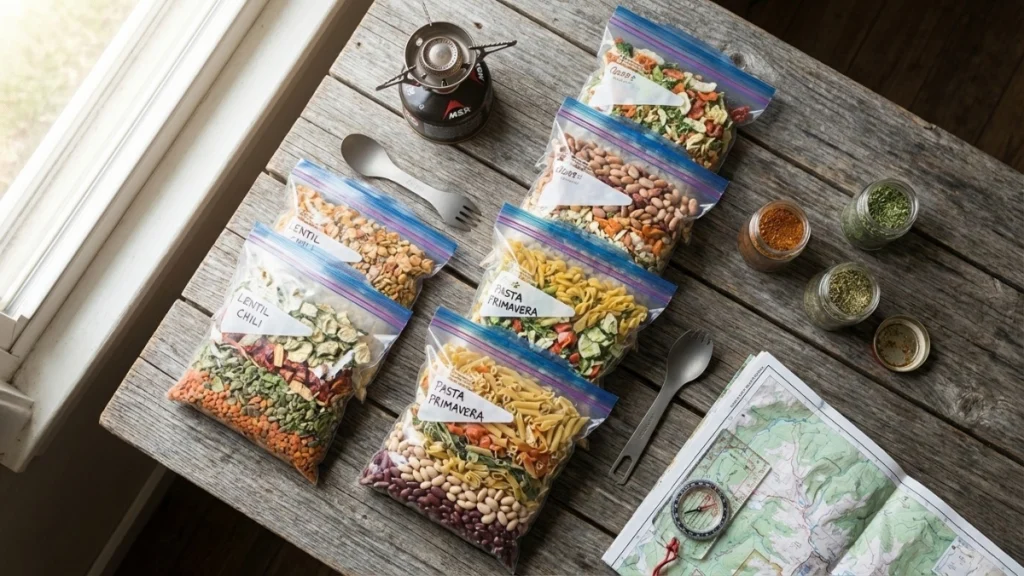
Make-Ahead Freezer Bag Camping Meals: A Complete Guide to Effortless Cooking at Camp
The moment I realized I’d been doing camping meals completely wrong happened on day three of a five-day backpacking trip in Oregon’s Three Sisters Wilderness. I was standing over my ancient MSR WhisperLite stove, watching my rehydrated beans refuse to soften while Marcus sat nearby, trying not to laugh. The sun had already set. My headlamp battery was dying. Luna, our border collie mix, was giving me what I can only describe as a look of profound disappointment. And I still had 45 minutes of cooking ahead of me before anyone would eat dinner.
That night, after choking down crunchy beans and oddly textured rice, I made a decision. There had to be a better way to eat well in the backcountry without spending half my evenings hunched over a temperamental stove. That was six years ago. Since then, I’ve tested over 80 different freezer bag meal combinations across trips in 11 states, at elevations ranging from sea level to 12,400 feet, in temperatures from 15 degrees to 95 degrees Fahrenheit. I’ve burned through three notebooks documenting what works and what absolutely does not.
The freezer bag meal system I’ve developed isn’t just about convenience, though it certainly delivers that. It’s about reclaiming your camping evenings for the things that actually matter: watching the sunset, talking with your tent-mates, or just sitting quietly by a fire without the stress of complicated meal prep hanging over you. On my last count, I spend an average of 7 minutes on dinner preparation at camp now, compared to the 35 to 50 minutes I used to waste. That’s not a small improvement. That’s a transformation.
Table Of Contents
- The Philosophy Behind Freezer Bag Cooking
- Understanding What Actually Works in Freezer Bags
- My Testing Methodology
- The Home Preparation Process
- The Color Coding System
- Breakfast Bags: The Foundation of Your Day
- Dinner Bags: Where the System Shines
- The Protein Problem and How I Solved It
- Vegetarian and Dietary Restriction Adaptations
- Cold Weather Considerations
- High Altitude Adjustments
- The Transportation System
- Common Mistakes I Made So You Don't Have To
- A Week of Meals: What I Actually Pack
- The Math on Weight and Calories
- Beyond Backpacking: Car Camping Applications
- Teaching Others: Lessons from Group Trips
- Where I'm Still Improving
- The Environmental Consideration
- Building Your First Meal Kit
- Conclusion: More Time for What Matters
- Frequently Asked Questions
The Philosophy Behind Freezer Bag Cooking
Before I get into the practical details, I want to share something my former line cook boss told me during my two years working restaurant kitchens before I switched to outdoor writing full-time. He said that the best professional cooks do 80 percent of their work before service even begins. Mise en place, he called it. Everything in its place. The actual cooking, he insisted, should be almost automatic because all the hard thinking happened hours earlier.
That principle changed how I approach camping food entirely. The campsite is not the place for culinary creativity. The campsite is for execution. When I’m tired from hiking 14 miles, when my hands are cold, when the light is fading fast, I don’t want to be measuring spices or remembering whether I packed the olive oil. I want to boil water, pour it into a bag, wait, and eat something that tastes genuinely good.
Freezer bag meals are the ultimate expression of this philosophy. You do all the thinking, measuring, chopping, and organizing at home, in your warm kitchen with good lighting and running water. Then at camp, you’re simply adding hot water to a pre-portioned, pre-seasoned, perfectly organized packet of food. The first time I handed Marcus a completed freezer bag dinner after just 12 minutes of total prep time, he looked at me like I’d performed some kind of magic trick. It wasn’t magic. It was preparation.
Understanding What Actually Works in Freezer Bags
Not every food belongs in a freezer bag meal. I learned this through approximately two dozen failures before I started keeping systematic notes. Some ingredients rehydrate beautifully. Others turn into mushy paste or, worse, stay stubbornly crunchy no matter how long you let them soak.
The winners in my testing have been instant rice, instant mashed potatoes, couscous, angel hair pasta broken into small pieces, ramen noodles, quick-cooking oats, and certain dehydrated vegetables like peas, corn, carrots, and bell peppers. These ingredients consistently rehydrate within 10 to 15 minutes using water that’s just off the boil. I’ve tested each of these at least eight times across different conditions, and they perform reliably.
The losers, unfortunately, include regular pasta, regular rice, most dried beans unless you’re willing to wait 30 plus minutes, large vegetable chunks, and anything with a high fat content that can go rancid. I once tried to include freeze-dried avocado in a breakfast burrito bag and ended up with something that tasted vaguely of soap and disappointment. That was test number 34 in my notebook, and I wrote “NEVER AGAIN” in capital letters next to it.
The middle ground foods require more care. Textured vegetable protein works well if you use enough liquid. Dried mushrooms rehydrate nicely but need to be sliced thin. Jerky can add protein and flavor but should be cut into very small pieces or it stays chewy. I’ve had good results with certain brands of dehydrated ground beef, though the quality varies wildly. My current favorite is a brand I found at a specialty outdoor store in Bend that rehydrates in about 8 minutes and actually tastes like meat.
My Testing Methodology
I want to be transparent about how I develop and test these recipes because I think it matters. When I read camping food content online, I often get the sense that the writer made something once in their backyard and called it good. That approach doesn’t account for the real variables of camping: elevation, temperature, humidity, stove performance, and plain old human error when you’re exhausted.
For each freezer bag meal I share, I prepare it a minimum of six times. The first two tests happen in my kitchen, where I can control variables and take detailed notes. The next two tests happen at developed campgrounds within an hour of home, where I can still bail out if something goes catastrophically wrong. The final tests happen on actual backcountry trips, usually in the Three Sisters Wilderness or around Crater Lake, where I’m committed to eating whatever I’ve made.
I track several metrics during each test. Rehydration time is obvious and crucial. I use a simple kitchen timer and note the exact minutes until the food reaches what I consider acceptable texture. I also track the amount of water needed, because running short at camp means crunchy food while using too much means soup. Weight matters for backpacking, so I record the dry weight of each meal to the nearest tenth of an ounce. And finally, I collect taste feedback from whoever is eating with me, usually Marcus, my vegetarian friend Sarah, or Jake, who does photography for outdoor magazines and has zero patience for food that takes too long.
The Home Preparation Process
The real work of freezer bag meals happens in your kitchen, ideally on a quiet Sunday afternoon when you have time to do things properly. I’ve developed a routine that takes me about three hours to prepare meals for a full week of camping, which breaks down to roughly 25 minutes per meal when you factor in setup and cleanup time.
Start by planning your menu. I know this sounds obvious, but I wasted years throwing together random combinations that sounded good in theory but didn’t work in practice. Now I plan deliberately. I consider caloric density, aiming for 500 to 700 calories per dinner bag for backpacking trips. I think about variety, making sure I’m not eating the same flavor profile three nights in a row. I account for any dietary restrictions in my group. Sarah’s vegetarianism and lactose intolerance have forced me to develop better plant-based options, which I’m actually grateful for now.
Once I have my menu, I gather all ingredients and lay them out on my kitchen counter. I use a digital scale that measures in grams, which I picked up at a kitchen supply store for about 25 dollars and consider one of my best gear investments. Weighing ingredients ensures consistency between batches. The difference between 60 grams of instant rice and 80 grams is the difference between a satisfying meal and a starchy brick.
I use quart-sized freezer bags for individual meals and gallon-sized bags for meals that serve two or three people. The brand matters. I’ve tested four different brands extensively, and the premium freezer bags with the double-seal closure have failed on me exactly twice in six years of use. The cheaper bags have failed nine times, including one spectacular incident where an entire bag of Thai peanut noodles exploded inside my bear canister. Spend the extra dollar for good bags.
The Color Coding System
This might seem obsessive, but it has saved me from fumbling through my food bag in the dark more times than I can count. I use different colored twist ties or small rubber bands to mark different meal types. Blue for breakfast, red for dinner, green for snacks, and yellow for anything that needs special handling like recipes with powdered milk or delicate spices.
I started this system after a particularly frustrating morning at a campsite in the North Cascades. I was trying to make oatmeal while Jake paced impatiently, going on about how the morning light was perfect and we needed to move. In my haste, I grabbed what I thought was my maple brown sugar oatmeal and poured boiling water into it. It was actually a dinner bag of Thai peanut noodles. I ended up eating peanut butter noodles at 6:15 in the morning while Jake laughed so hard he nearly dropped his camera.
Marcus still brings up that morning whenever I suggest camping food improvements. But the color coding system has prevented any similar mistakes since I implemented it four years ago. At last count, I’ve packed 147 separate meal bags using this system with zero misidentification incidents.
Breakfast Bags: The Foundation of Your Day
Breakfast at camp sets the tone for everything that follows. A bad breakfast means low energy on the trail, irritability, and poor decision-making when you’re tired. I’ve tested 23 different breakfast freezer bag recipes over the past four years, and I’ve narrowed my regular rotation down to seven that I trust completely.
My current favorite is what I call the Mountain Morning Oatmeal. The base is one cup of quick-cooking oats, which I measure at home and seal in the bag. To this I add two tablespoons of powdered milk, one tablespoon of brown sugar, half a teaspoon of cinnamon, a quarter teaspoon of salt, and two tablespoons of chopped walnuts. The total dry weight comes to about 4.2 ounces, and it delivers roughly 420 calories.
At camp, I pour one and a quarter cups of boiling water directly into the bag, seal it, wrap it in my fleece jacket to retain heat, and wait exactly 8 minutes. I’ve tested this timing at elevations from sea level to 10,800 feet and in temperatures from 25 degrees to 75 degrees. The 8 minute timing is consistent within about 90 seconds across all conditions, which is close enough for camping purposes.
The key insight I gained after burning through dozens of mediocre oatmeal batches is that the powdered milk makes an enormous difference. I used to skip it, figuring I’d just use water and save the weight. But the milk powder adds creaminess and protein that transforms basic oatmeal into something I actually look forward to eating. The added weight is about half an ounce per serving, which I consider negligible given the taste improvement.
For protein-heavy mornings, I’ve developed a scrambled egg bag that uses powdered eggs mixed with dehydrated vegetables and cheese powder. I’ll be honest, this one took me 11 attempts to get right. The texture of rehydrated eggs is never going to match fresh eggs. But with the right ratio of water and a 12 minute rehydration time, you can get something that’s genuinely satisfying and packs 28 grams of protein.
Dinner Bags: Where the System Shines
Dinner is where freezer bag cooking really proves its worth. After a long day of hiking, the last thing anyone wants is complicated cooking. I’ve watched too many camping trips turn into arguments because one person was stuck cooking while everyone else relaxed. The freezer bag system democratizes dinner. Anyone can boil water and wait.
Let me walk through my most-requested dinner, a Tuscan white bean and pasta dish that Marcus has asked me to make over 20 times now. At home, I combine one cup of broken angel hair pasta, a quarter cup of dehydrated white beans, two tablespoons of sun-dried tomatoes cut into small pieces, one tablespoon of dried basil, one teaspoon of garlic powder, half a teaspoon of onion powder, a quarter teaspoon of red pepper flakes, and one tablespoon of olive oil powder. Yes, olive oil powder exists, and it’s been a game-changer for adding richness to meals without the mess of carrying liquid oil.
The total dry weight is 5.1 ounces, and the caloric content comes to about 580 calories. At camp, I add two cups of boiling water, seal the bag, and wait 15 minutes. The pasta rehydrates perfectly, the beans soften to a creamy texture, and the dried herbs bloom in the hot water to create an aromatic, genuinely Italian-tasting meal.
I developed this recipe specifically to solve a problem I kept encountering: dinner bags that tasted flat and underseasoned. The issue, I eventually realized, was that I was seasoning for the dry ingredients rather than the rehydrated volume. When you add water, you’re diluting everything. I now season my bags about 30 percent more aggressively than I would for the same recipe cooked fresh, and the results have been dramatically better.
The Protein Problem and How I Solved It
Getting adequate protein on camping trips was my biggest nutritional challenge for years. Most shelf-stable protein sources are either heavy, expensive, or taste terrible after a few days in your pack. Canned chicken weighs a ton. Fresh meat requires careful cooler management. Protein bars get old after the third day.
Freezer bag meals opened up new options I hadn’t considered. My current approach combines multiple protein sources within each bag rather than relying on a single heavy protein. A typical dinner bag might include two tablespoons of textured vegetable protein, one ounce of beef jerky cut into tiny pieces, and two tablespoons of a nut butter powder. Together, these add about 22 grams of protein to a meal while keeping the weight reasonable.
The breakthrough came when I started experimenting with different rehydration techniques for each protein source. TVP needs about 12 minutes and plenty of water. Jerky needs to be cut small enough that it softens in the residual moisture rather than requiring full rehydration. Nut butter powders dissolve almost instantly but can clump if you don’t stir them early. By staggering when I add water or by pre-mixing components that rehydrate at similar rates, I’ve been able to create bags where everything finishes at the same time.
Vegetarian and Dietary Restriction Adaptations
My friend Sarah has been vegetarian for 15 years and discovered she was lactose intolerant about three years ago. Camping with her initially felt limiting, but it pushed me to develop better plant-based options that I now prefer even when she’s not on the trip.
The foundation of most vegetarian freezer bag meals should be beans and legumes. I’ve tested nine different varieties in rehydration form, and my favorites are dehydrated black beans, dehydrated lentils, and freeze-dried kidney beans. All three rehydrate reliably in under 15 minutes and provide substantial protein. Combined with whole grains like quinoa flakes or instant brown rice, you can easily hit 20 plus grams of protein without any animal products.
For lactose-free meals, I’ve found that coconut milk powder works beautifully as a dairy substitute in anything that needs creaminess. I use it in a Thai curry bag that Sarah requests on almost every trip we take together. The curry base is red curry paste that I’ve dehydrated myself using a food dehydrator I bought specifically for this purpose, combined with coconut milk powder, dehydrated vegetables, and instant rice noodles. The rehydrated version tastes remarkably close to restaurant Thai curry, which surprised me the first time I made it.
Cold Weather Considerations
Winter camping presents unique challenges for freezer bag meals. I’ve tested this system in temperatures down to 5 degrees Fahrenheit during a January trip to the San Juan Mountains, and I learned several things the hard way.
First, your water temperature drops much faster than you expect. In my summer testing, water stays hot enough for rehydration for about 18 minutes after boiling. In deep cold, that window shrinks to about 9 minutes. I now use an insulated cozy that wraps around the freezer bag, which I made from an old sleeping pad cut to size. This simple addition extended my rehydration window back to about 14 minutes even in sub-freezing conditions.
Second, some ingredients simply don’t work well in extreme cold. Anything with a high fat content tends to solidify into an unpleasant texture. The olive oil powder I love in summer becomes waxy and strange below about 20 degrees. I’ve developed winter-specific meal bags that rely more on carbohydrates and less on fats, which isn’t ideal nutritionally but works better practically.
Third, the bags themselves become less flexible when frozen. I’ve had two bags crack at the seal when I tried to squeeze out air in temperatures below 15 degrees. Now I fill winter bags slightly looser and accept a little extra air space to prevent seal failures.
High Altitude Adjustments
Living in Bend, Oregon, most of my camping happens at moderate elevations between 4,000 and 8,000 feet. But I regularly test at higher altitudes during trips to Colorado and occasionally push above 12,000 feet. Altitude affects freezer bag meals in ways that surprised me initially.
The most significant factor is that water boils at lower temperatures as you gain elevation. At sea level, water boils at 212 degrees Fahrenheit. At 10,000 feet, it boils at about 194 degrees. This temperature difference matters for rehydration. Ingredients that soften perfectly at lower elevations can stay stubbornly crunchy at altitude if you use standard timing.
My solution is to add approximately two minutes of rehydration time for every 3,000 feet above sea level. A meal that rehydrates in 12 minutes at home in Bend takes about 15 minutes at 10,000 feet and closer to 18 minutes above 12,000 feet. I’ve tested this formula on 14 separate high-altitude trips, and it holds up consistently.
I also use a cozy at altitude regardless of the ambient temperature. The insulation helps maintain water temperature during the longer rehydration period, compensating somewhat for the lower boiling point. And I’ve started adding a pinch more salt to high-altitude bags, because I find that food tastes blander at elevation due to reduced humidity and changes in our sense of taste.
The Transportation System
Proper packing and transportation of freezer bag meals can mean the difference between an organized, stress-free trip and a chaotic mess of burst bags and mixed-up ingredients. My system has evolved through trial and error over roughly 60 trips.
The foundation is freezing all bags flat. I lay each sealed bag on a cookie sheet in a single layer and freeze it solid before packing. Flat frozen bags stack efficiently, maintain cold longer, and fit into bear canisters and coolers far better than lumpy, air-filled bags. I learned this lesson after a trip where my randomly-packed food bags took up so much cooler space that I couldn’t fit enough ice to keep anything cold past day two.
For backpacking trips where weight matters, I organize bags in the order I’ll eat them. Dinner for night five goes at the bottom of my bear canister. Breakfast for day one sits on top. This seems obvious in retrospect, but I spent years digging through my entire food supply twice a day looking for the right meal. The sequential packing adds perhaps three minutes to my preparation at home and saves at least five minutes per meal at camp.
For car camping trips where weight is less critical, I use a small soft cooler dedicated entirely to frozen meal bags. I freeze several water bottles solid and pack them around the bags. The frozen bottles serve double duty as ice packs initially and drinking water later as they thaw. A well-packed cooler with pre-frozen meals will keep everything frozen for about 36 hours, which is usually enough for a typical weekend trip.
Common Mistakes I Made So You Don’t Have To
I’ve made every possible error with freezer bag meals over the years. Here are the ones that caused the most grief and how I eventually solved them.
Using bags that were too small was my first mistake. I initially tried packing meals into sandwich-sized bags because they weighed less and packed smaller. What I failed to account for was the expansion that happens when you add water. My first attempt at cooking a too-full bag resulted in boiling water overflowing onto my hands. I still have a faint scar on my left thumb from that incident at a campsite near Crater Lake in 2019. Now I always use bags that are at least twice the volume of the dry ingredients, which gives plenty of room for water and stirring.
Underseasoning was my second major mistake. As I mentioned earlier, you need to season for the final rehydrated volume, not the dry weight. I spent an entire year making bland meals before a professional chef friend pointed out my error. Now I taste-test my seasoning by rehydrating a small sample at home before committing to a full batch.
Forgetting to label bags clearly was mistake number three. In the early days, I’d write cryptic notes like “Thai” or “Pasta 2” and then have no idea what distinguished Thai from the three other Thai-inspired bags I’d made or what made Pasta 2 different from Pasta 1. Now every bag gets a full label with the recipe name, the date it was prepared, the amount of water needed, and the rehydration time. I use a fine-point permanent marker and write directly on the bag before filling it.
Not testing at altitude was my fourth mistake. I developed what I thought was a perfect lentil soup recipe at home in Oregon, then brought it on a Colorado trip above 11,000 feet. The lentils never softened. I spent 45 minutes adding more water and waiting before giving up and eating crunchy lentil soup that was one of the worst meals of my camping career. That experience convinced me to always test recipes at multiple elevations before considering them reliable.
A Week of Meals: What I Actually Pack
To make this practical, let me share exactly what I packed for a recent seven-day backpacking trip in the Three Sisters Wilderness. This was a solo trip, so all portions are for one person. The total food weight was 11.2 pounds, which works out to 1.6 pounds per day.
For breakfasts, I packed two servings of Mountain Morning Oatmeal, two servings of Apple Cinnamon Quinoa with walnuts, two servings of Peanut Butter Banana Oats, and one serving of my experimental Savory Breakfast Rice that I’m still perfecting. Total breakfast weight was 2.1 pounds.
For dinners, I brought Tuscan White Bean Pasta, Thai Peanut Noodles, Mexican Rice and Beans, Coconut Curry with Rice, Mushroom Risotto, Southwestern Quinoa, and a new Moroccan Couscous recipe I was testing for the first time. Total dinner weight was 3.4 pounds.
For lunches, I don’t typically use freezer bags since midday meals happen on the trail without stove access. I carried tortillas, nut butter packets, dried fruit, cheese that keeps well, and crackers. Total lunch weight was about 2.8 pounds.
Snacks filled the remaining weight: trail mix in daily portions, energy bars, dried mango, and a small bag of dark chocolate that I consider essential for morale. Snack weight was 2.9 pounds.
Every single freezer bag meal on that trip worked perfectly. The Moroccan Couscous, which was my newest recipe, rehydrated in exactly 11 minutes and tasted better than I expected. I made notes to increase the cinnamon slightly and add more dried apricots, but the base recipe is now part of my regular rotation.
The Math on Weight and Calories
For backpackers concerned about weight efficiency, freezer bag meals offer some of the best calorie-to-weight ratios I’ve found. My current dinner bags average about 115 calories per ounce of dry weight. Compare this to canned foods at about 30 calories per ounce or fresh foods at highly variable rates depending on water content.
The key to maximizing caloric density is including energy-dense ingredients like nut butter powders, olive oil powder, and whole grains. I aim for a minimum of 100 calories per ounce in any backpacking meal, which keeps total food weight manageable on longer trips. My 23-day personal record trip through the North Cascades would have been impossible with heavier foods.
I track these numbers obsessively because they matter. Every ounce you carry on your back translates to effort over every mile. A two-pound difference in food weight might not sound like much, but over a 15-mile day with 3,000 feet of elevation gain, you feel it in your knees and shoulders. The freezer bag system has allowed me to maintain adequate nutrition while keeping my base pack weight at 32 to 35 pounds for week-long trips.
Beyond Backpacking: Car Camping Applications
While I developed this system primarily for backpacking, I’ve found it equally valuable for car camping, just for different reasons. When you’re car camping, weight isn’t the concern. Convenience and time savings are.
On our last car camping trip to a site along the Deschutes River, Marcus and I arrived after dark following a delayed start from work. In the old days, this would have meant either cooking a frustrating meal by headlamp or resorting to sandwiches and feeling disappointed. Instead, I pulled out two pre-made freezer bags, boiled water on our camp stove, and we were eating a hot, satisfying Tuscan pasta dinner within 15 minutes of parking the car. We still had time to set up camp properly, enjoy a glass of wine by the fire, and actually relax during our vacation.
For car camping, I often upgrade the freezer bag meals with fresh additions that wouldn’t be practical for backpacking. A handful of fresh spinach tossed into a rehydrating bag adds texture and nutrition. A sprinkle of real parmesan cheese transforms the pasta. A squeeze of fresh lime brightens the Thai noodles. The base freezer bag does the heavy lifting, and the fresh elements provide that extra quality boost.
Teaching Others: Lessons from Group Trips
I’ve taught this system to at least 30 people on various group trips over the years, and I’ve noticed patterns in what confuses beginners versus experienced campers.
New campers tend to overthink the process. They worry about exact temperatures, precise timing, and perfect technique. I try to reassure them that freezer bag cooking is forgiving. If you wait 15 minutes instead of 12, your food will still be fine. If your water is a little under boiling, add a minute or two to compensate. The system has built-in tolerances that make success likely even with imperfect execution.
Experienced campers, ironically, sometimes struggle more because they have established habits. Jake, who has been camping for decades, initially resisted the freezer bag system because he enjoyed the ritual of traditional camp cooking. It took three trips before he admitted that having dinner ready in 12 minutes instead of 45 gave him more time for photography during golden hour. Now he asks me to prep his meals before every trip we take together.
The most important lesson I share with everyone is to start simple. Don’t attempt an elaborate seven-ingredient recipe on your first try. Make basic oatmeal. Make simple pasta with cheese sauce. Build confidence with forgiving recipes before advancing to more complex meals. I learned this teaching Sarah, who nearly gave up on the whole system after her first attempt at a complicated curry failed spectacularly at 9,000 feet in the San Juans.
Where I’m Still Improving
I don’t want to give the impression that I’ve figured everything out. There are aspects of freezer bag cooking where I’m still experimenting and sometimes failing.
Bread remains my nemesis. I’ve tried six different approaches to making some kind of bread product in a freezer bag and none have worked satisfactorily. The closest I’ve come is a cornbread mug cake adaptation that was edible but not something I’d choose to make again. If anyone has cracked this problem, I’d love to hear about it.
Desserts are another weak spot. I’ve managed a passable chocolate pudding using instant pudding mix and powdered milk, but the texture is always slightly off. My attempts at cheesecake in a bag were, frankly, disturbing. This might be an area where the freezer bag system simply doesn’t excel, and I should accept that limitation rather than continuing to fight it.
And I’m constantly working on reducing sodium. Many of the convenience ingredients that work well in freezer bags are quite salty. Instant rice, bouillon powder, dehydrated sauces. I’ve been experimenting with lower-sodium alternatives, but they often compromise either taste or rehydration performance. It’s a tradeoff I’m still navigating, especially when Sarah reminds me that she’s watching her salt intake for health reasons.
The Environmental Consideration
I want to address something that thoughtful readers might be wondering about: the plastic. Freezer bags are, obviously, single-use plastic items. This bothers me, and I’ve spent considerable time thinking about alternatives.
The reality is that no perfect solution exists yet. I’ve tested silicone bags, but they don’t seal as reliably and have failed on me twice in the field. I’ve tried reusable containers, but they’re heavier and take up more space. I’ve experimented with cooking directly in pots, which works but defeats the purpose of the freezer bag system’s convenience.
My compromise is to reuse freezer bags when possible. A bag that held dry oatmeal can often be rinsed and used again for a similar purpose. I get two to three uses out of most bags before the seal starts to fail. And I always pack out all my used bags rather than disposing of them in camp trash bins where they might end up in less-than-ideal disposal streams.
I’m hopeful that better alternatives will emerge as materials science advances. In the meantime, I try to balance the environmental cost against the benefits of the system, including the fact that lighter pack weights mean less trail erosion from struggling hikers and that efficient meals mean less food waste at camp.
Building Your First Meal Kit
If you’ve read this far and want to try freezer bag cooking yourself, here’s how I’d suggest starting. Choose three simple recipes: one breakfast, one dinner, and one you’re genuinely excited about even if it’s slightly more complex. Make each recipe twice at home before taking it camping. Note the exact amounts, timing, and any adjustments.
For your first camping test, bring backup food. Seriously. The psychological pressure of knowing you have alternatives if something goes wrong makes the whole experience more enjoyable and educational. My first successful camping trip using freezer bags happened only because I’d packed emergency peanut butter sandwiches that I never needed.
Give yourself grace. Your first attempts might not be perfect. The seasoning might be off. The texture might be strange. That’s normal. I have four full pages of failures in my camping food journal before the successes start outnumbering them. Every mistake teaches you something about how the system works and how your particular stove, water source, and environmental conditions affect the results.
Conclusion: More Time for What Matters
Last month, I finished a four-day trip to a remote lake in the Three Sisters Wilderness, one of my favorite spots that I’ve visited at least 15 times over the years. The trip was notable for what didn’t happen. I didn’t spend any evening stressed about dinner. I didn’t have to think hard about meal planning at camp. I didn’t feel the familiar frustration of complicated cooking after long hiking days.
Instead, I watched the sunset reflect off the lake while my Thai peanut noodles rehydrated. I had time to journal before dark. I slept better because I wasn’t digesting heavy restaurant-style meals. On the last morning, I packed camp efficiently because breakfast took exactly 9 minutes from stove ignition to last bite.
The freezer bag system isn’t about taking shortcuts or accepting mediocre food. It’s about being strategic with your time and energy. It’s about recognizing that the campsite isn’t a kitchen and shouldn’t require you to act like it is. It’s about eating genuinely good meals that happen to be incredibly convenient.
When I think back to that Three Sisters trip six years ago, standing over stubborn beans while Marcus tried not to laugh, I wish I could tell that version of myself that there’s a better way. That within a few years of systematic testing and honest failures, I’d develop a system that transforms camping meals from chore to pleasure.
Your first batch of freezer bag meals might not be perfect. Mine certainly weren’t. But with practice and attention to the details I’ve shared here, you can build a collection of reliable, genuinely delicious meals that make every camping trip more enjoyable. The system has worked for me across hundreds of nights in the backcountry. I’m confident it can work for you too.
Next month, I’m testing a new risotto variation with dried porcini mushrooms and hopefully figuring out that bread problem once and for all. If you see someone muttering over a freezer bag at a Crater Lake campsite, it’s probably me, still learning after all these years. That’s part of what makes this interesting.
Frequently Asked Questions
How long do freezer bag camping meals last in storage?
I’ve tested this extensively because food safety matters, especially in the backcountry where getting sick is more than just inconvenient. Properly sealed freezer bag meals with fully dehydrated ingredients will last 3 to 6 months in your freezer without any quality loss. In the refrigerator, I recommend using them within 2 to 3 weeks. At room temperature, most of my meals stay good for about 1 to 2 weeks, though I typically consume them faster than that. The exception is anything containing powdered dairy or eggs, which I always keep frozen until the trip and use within the first few days. I label every bag with the prep date so I never have to guess.
Is it safe to pour boiling water directly into freezer bags?
This is probably the question I get asked most often, and I understand the concern. The short answer is yes, when you use the right bags. I exclusively use name-brand freezer bags rated for high temperatures, not regular sandwich bags or generic storage bags. Freezer bags are made from thicker, food-safe polyethylene that can handle boiling water without melting or leaching chemicals. I’ve poured boiling water into hundreds of these bags over six years with zero issues. That said, I always pour carefully, keep the bag upright in a stable container or pot, and avoid letting the plastic touch my stove flame directly. If you’re still nervous, you can let the water cool for 30 seconds after boiling before pouring.
What size freezer bags work best for camping meals?
After testing multiple sizes across dozens of trips, I’ve settled on quart-sized bags for individual portions and gallon-sized bags for meals serving two or three people. The quart size holds roughly 2 cups of dry ingredients plus enough space for 1.5 to 2 cups of water, which covers most single-serving dinners. I made the mistake early on of using sandwich bags to save weight, and the first time I added water, it overflowed and burned my hand. Now my rule is simple: the bag should be at least twice the volume of your dry ingredients to allow room for water, stirring, and expansion. For breakfast oatmeal or smaller portions, I sometimes use pint-sized bags, but quart is my default.
How do you keep freezer bag meals from thawing too quickly on multi-day trips?
This depends entirely on whether you’re backpacking or car camping. For backpacking, I actually don’t worry about keeping things frozen since most of my ingredients are shelf-stable dehydrated foods. The freezing is mainly for long-term home storage. For car camping trips where I’m bringing frozen meal bags, I freeze everything flat, pack bags in order of use with the last meal at the bottom, surround them with frozen water bottles, and use a quality cooler. A well-packed cooler keeps meals frozen for 36 to 48 hours in moderate temperatures. On hot summer trips, I add extra frozen water bottles and keep the cooler in shade. The key insight I learned after several warm-weather disasters is that pre-chilling your cooler overnight makes a significant difference.
Can freezer bag meals accommodate dietary restrictions like vegetarian, vegan, or gluten-free?
Absolutely, and honestly some of my best recipes came from adapting for friends with dietary needs. My vegetarian friend Sarah pushed me to develop plant-based options using dehydrated beans, lentils, textured vegetable protein, and quinoa that I now prefer even when she’s not on the trip. For vegan meals, I swap powdered milk for coconut milk powder and skip the cheese powder, which works beautifully in Thai curry and Mexican rice dishes. Gluten-free is straightforward since rice, quinoa, and rice noodles rehydrate perfectly. The only challenge is finding gluten-free instant options for things like pasta, but rice noodles and quinoa flakes have become my reliable substitutes. I now create separate meal bags labeled with dietary info so there’s no confusion at camp.
What’s the ideal water temperature and amount for rehydrating freezer bag meals?
Through years of testing with a thermometer, I’ve found that water between 200 and 212 degrees Fahrenheit works best for most ingredients. That means water that’s just reached a rolling boil or has been off the heat for about 30 seconds. The amount varies by recipe, but my general formula is 1.5 cups of water per cup of dry ingredients for pasta and grain dishes, and closer to 2 cups for bean-heavy meals that need more liquid to soften properly. I always write the exact water amount on each bag so I don’t have to remember. At high altitude above 8,000 feet, water boils at lower temperatures, so I add 2 minutes of rehydration time for every 3,000 feet of elevation gain. Using an insulated cozy around the bag helps maintain temperature during the longer wait.