
Travel Food Safety and Health Precautions: What 85 Countries and One Very Bad Night in Cairo Taught Me
The worst food poisoning of my life happened in Egypt, but not where you’d expect. It wasn’t from a street cart in a dusty Cairo alley or a questionable lamb kebab from a night market vendor. It was from a Caesar salad at a four-star hotel restaurant, the kind of place with white tablecloths and waiters in pressed shirts. I spent the next 36 hours in a bathroom that seemed miles away from my bed, contemplating every life choice that had led me to that moment.
That was 2017. Since then, I’ve eaten my way through 85 countries, consumed street food on six continents, and learned more about food safety than I ever wanted to know. Here’s what nobody tells you about staying healthy while eating your way around the world: the danger usually isn’t where you think it is, the precautions most travel guides recommend are often wrong, and your gut is smarter than you give it credit for, but it needs time to adjust.
Let me be clear about something before we go any further. I’m not a doctor, and I’m not going to pretend that my decade of eating questionable things in questionable places makes me a medical expert. What I can offer is practical, hard-won knowledge from someone who has made nearly every mistake possible and lived to write about it. I’ve had giardia in Guatemala, something unnamed but memorable in Vietnam, and a 72-hour situation in India that I still don’t fully understand. But I’ve also eaten street food in Bangkok for weeks without incident, survived an entire month of market eating in Mexico City, and navigated the food stalls of Marrakech with nothing more than a slightly expanded waistline.
The difference between getting sick and staying healthy abroad often comes down to decisions that seem trivial in the moment but matter enormously. And most of those decisions have nothing to do with avoiding street food.
Table Of Contents
- The Hotel Restaurant Paradox
- Understanding the Real Risks
- The Water Question
- The Temperature Rules That Actually Work
- The Adjustment Period: Stop Fighting It
- Reading the Signs: What to Look For
- The Medicine Kit: What I Actually Carry
- Regional Considerations: What Changes Where
- When Things Go Wrong: What I Actually Do
- The Psychological Component
- Building Gut Resilience
- What I Tell First-Time Travelers
- Conclusion: Trust the Process
- Frequently Asked Questions
- Is street food actually safe to eat, or should I stick to restaurants when traveling?
- How long does traveler's diarrhea typically last, and when should I see a doctor?
- Should I avoid all ice and raw vegetables when traveling in developing countries?
- What vaccinations and medications should I get before a food-focused trip abroad?
- How can I safely eat seafood while traveling, especially in tropical destinations?
- Is it true that your stomach can adapt to local bacteria over time, and how can I speed up that process?
The Hotel Restaurant Paradox
After my Cairo incident, I started paying closer attention to where I actually got sick versus where I assumed I would get sick. The pattern was surprising. Over 11 years of serious food travel, I’ve gotten genuinely ill exactly seven times. Three of those incidents happened at hotels or tourist-oriented restaurants. Two happened at places recommended by guidebooks. Only two happened at street vendors or local markets, and in both cases, I could trace the problem to my own poor judgment rather than the food itself.
This isn’t just my experience. Talk to enough seasoned travelers and you’ll hear similar stories. The street vendor who’s been making the same dish for 30 years, who depends on repeat customers from the neighborhood, who cooks everything fresh in front of you, is often safer than the hotel buffet where food sits under heat lamps for hours and the kitchen staff rotates constantly.
In Hanoi, there’s a woman named Mrs. Thanh who runs a pho stall on Ly Quoc Su Street. She’s been there since 1987. She serves maybe 200 bowls a day, and everything, the broth, the herbs, the rice noodles, turns over constantly. Her kitchen, if you can call it that, is basically a cart on the sidewalk. But the broth is kept at a rolling boil, the herbs are washed in filtered water, and the meat goes from refrigeration to scalding broth to your bowl in under two minutes. I’ve eaten there at least 40 times over six visits to Vietnam. Never once have I felt even slightly off afterward.
Compare that to a hotel breakfast buffet I attended in Bali, where the scrambled eggs had developed a skin from sitting too long, the fruit salad looked like it had been cut the previous day, and the yogurt was warm to the touch. I skipped breakfast that day. Three people from my tour group didn’t, and two of them spent the next day in their rooms.
The lesson isn’t that street food is always safe and hotels are always dangerous. The lesson is that freshness and turnover matter more than setting, and that your eyes and nose are better judges than star ratings or price points.
Understanding the Real Risks
Before you can protect yourself, you need to understand what you’re actually protecting yourself from. Most travel food illness falls into a few categories, and they require different approaches.
Bacterial contamination, the kind that comes from improperly stored or handled food, is the most common culprit. This includes the usual suspects: salmonella, E. coli, campylobacter, and a host of others. These bacteria thrive in food that’s been sitting at room temperature too long, food that’s been contaminated by unwashed hands or dirty surfaces, or food that wasn’t cooked thoroughly enough to kill what was living in it.
Then there’s viral contamination, which is often waterborne. Hepatitis A, norovirus, and rotavirus all spread through contaminated water or food that’s been washed in contaminated water. This is where the “don’t drink the tap water” advice comes from, though as we’ll discuss, the reality is more nuanced than that simple rule suggests.
Parasites are another concern, particularly in regions with less developed sanitation infrastructure. Giardia, cryptosporidium, and various worms can all hitch a ride in contaminated food or water. These tend to cause longer-lasting problems than bacterial infections, sometimes persisting for weeks or months if untreated.
Finally, there’s traveler’s diarrhea from non-pathogenic sources, which is really just your gut reacting to unfamiliar bacteria. This isn’t food poisoning in the traditional sense. It’s your digestive system throwing a tantrum because it’s encountering microbial strains it’s never seen before. This is common, usually mild, and almost impossible to avoid entirely when you’re eating in a new environment.
Understanding these distinctions matters because the prevention strategies are different. You can avoid bacterial contamination by eating freshly cooked food. You can reduce viral and parasitic risks by being careful about water. But that last category, the adjustment period, is something you have to ride out. No amount of caution will prevent it entirely, and that’s actually okay.
The Water Question
Every travel guide in existence will tell you not to drink the tap water in developing countries, and that’s generally good advice. But the corollary, that bottled water makes you safe, is incomplete to the point of being misleading.
Yes, drink bottled water. But think about everything else that water touches. The ice in your drink was made from what water? The lettuce in your salad was washed in what water? The glass your beer came in was rinsed with what water? The toothbrush you just used, did you rinse it under the tap without thinking?
I learned this the hard way in Guatemala City in 2016. I was religious about bottled water. I checked seals on every bottle, avoided ice, the whole routine. Then I got sick anyway. It took me two days to realize that I’d been absentmindedly rinsing my toothbrush under the tap every morning and evening. Such a small thing, but it was enough.
The water issue also varies enormously by location. In Singapore, the tap water is perfectly safe and probably cleaner than what comes out of my faucet in Portland. In Tokyo, I drink tap water without a second thought. In Bangkok, I don’t, but the locals often do without issue because their guts are adapted to the local microbial environment. In rural Cambodia, I’m cautious about everything, including water used for cooking.
My approach now is to think about water in three tiers. First tier is drinking water, which should always be bottled or purified in high-risk areas. Second tier is incidental water, the ice, the washed vegetables, the rinsed utensils. In moderate-risk areas, I’m careful but not paranoid. In high-risk areas, I treat this the same as drinking water. Third tier is trace water, the stuff you can’t avoid, like the residual moisture on a plate or the water vapor in steam. At some point, you have to accept that you can’t eliminate all exposure, and obsessing over trace amounts will drive you crazy without meaningfully reducing your risk.
Here’s what I actually do. In places where I’m uncertain, I use bottled water for brushing teeth. I avoid ice unless I’m at a place I trust. I skip raw salads and unpeeled fruits during my first few days in a new country. And I pay attention to what the locals do. If a restaurant is full of local families with kids, the water situation is probably fine. If it’s all tourists, I’m more cautious.
The Temperature Rules That Actually Work
After a decade of careful observation and more than a few incidents of self-inflicted food poisoning, I’ve settled on a simple mental framework. Hot food should be hot, cold food should be cold, and anything in between is a gamble.
This sounds obvious, but think about how often it’s violated. The lunch buffet that’s been sitting at lukewarm temperature for three hours. The street meat that’s been pre-cooked and is now sitting at room temperature waiting for customers. The seafood display that’s been out since morning. The breakfast spread at your guesthouse where the eggs cooled an hour ago.
Bacteria multiply fastest in what food scientists call the danger zone, roughly between 40°F and 140°F, or about 4°C to 60°C. Food that stays in this range for more than two hours starts to become risky. Food that’s been there for four hours or more is rolling the dice.
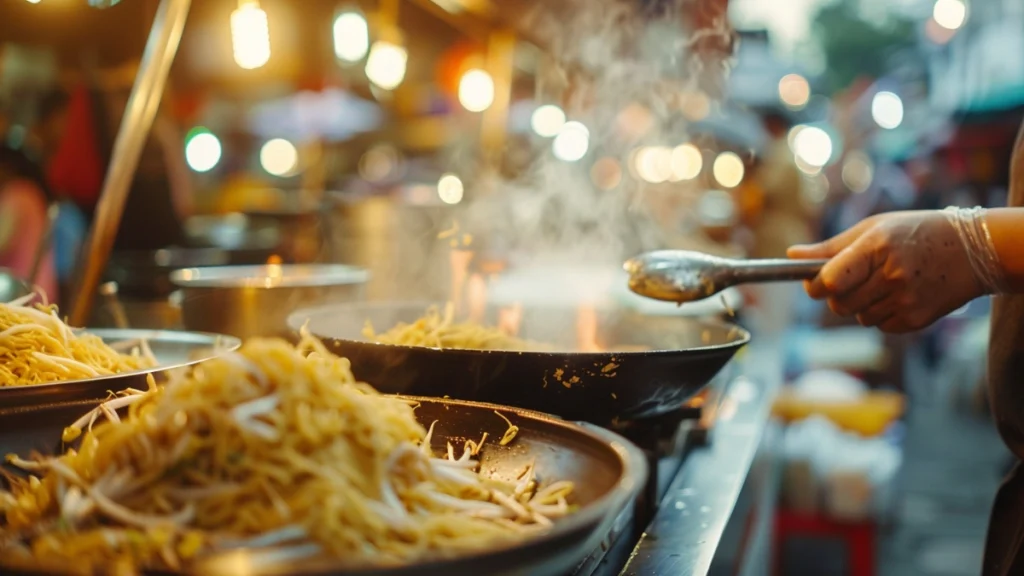
This is why I trust the blazing hot wok of a Thai street vendor more than the gently warmed chafing dish at a hotel buffet. The vendor’s food goes from raw to eating temperature in minutes. The buffet food might have been sitting at breeding temperature for hours.
I’ve developed a few personal rules based on this principle. If I can see steam rising from the cooking surface, that’s a good sign. If the cook is preparing food to order rather than from a pre-made batch, that’s better still. If the vendor has high turnover, meaning food doesn’t sit around waiting for customers, I’m more confident. And if something that should be hot is only warm when it reaches me, I either eat it immediately or skip it entirely.
In Bangkok, there’s a famous pad thai vendor near Thip Samai, a woman in her sixties named Nong, not to be confused with the main restaurant itself, who works a single wok over a flame so intense you can feel the heat from ten feet away. Every plate is cooked individually, and the noodles hit your table still slightly sizzling. I’ve eaten there maybe fifteen times. Never had a problem. Compare that to a well-reviewed restaurant in Chiang Mai where my pad thai arrived lukewarm and sat on my table for another ten minutes while I waited for my companion’s order. Something about that meal didn’t agree with me, and the temperature lapse is my primary suspect.
Cold food follows the same logic in reverse. Fresh ceviche prepared moments ago from fish that was on ice until the moment it was cut? Probably fine. The ceviche that’s been sitting in a display case in the afternoon sun at a beachside restaurant? I’ll pass.
The Adjustment Period: Stop Fighting It
Here’s something that most travel health advice gets wrong. Some digestive upset when you travel is normal, expected, and not actually food poisoning. It’s just your gut adjusting to a new microbial environment.
Your digestive system is home to trillions of bacteria, a complex ecosystem that has adapted over years to the foods you regularly eat and the microbes in your local environment. When you travel to a new place and eat new foods, you’re introducing bacteria that your gut has never encountered. Even if these bacteria aren’t pathogenic, meaning they won’t actually make you sick, they can still cause temporary digestive upset as your system figures out how to deal with them.
This is why so many travelers experience mild stomach issues in their first few days somewhere new, even when they’re being careful about food and water safety. It’s not necessarily that they ate something bad. It’s that their gut is recalibrating.
I’ve learned to account for this in how I plan my trips. During my first two or three days in a new country, I eat somewhat conservatively. Not because I’m afraid of the food, but because I want to give my system time to adjust before I start pushing the boundaries. I stick to cooked foods, avoid raw preparations, and keep portions moderate. By day four or five, once my gut has had time to adapt, I’m usually ready to eat more adventurously without incident.
I also take probiotics when I travel, starting a few days before departure and continuing throughout the trip. The science on this is mixed, and I’m not going to claim it’s a magic bullet. But anecdotally, I seem to have fewer issues when I maintain the probiotic routine, and at minimum, it’s doing no harm.
The other thing I’ve learned is to stay hydrated and keep eating, even when I feel slightly off. The worst thing you can do during that adjustment period is stop eating entirely. Your gut needs input to normalize, and depriving it of food only prolongs the recalibration process. I aim for simple, easily digestible foods during these times. Plain rice, clear broths, bananas, plain bread. Nothing fancy, but enough to keep the system working.
Reading the Signs: What to Look For
Over the years, I’ve developed a mental checklist that I run through before eating somewhere new. It’s not foolproof, and I’ve certainly been wrong in both directions. But it helps me make better decisions more often than not.
First, I look at turnover. Is food moving quickly, with a constant flow of customers and constant cooking? Or is food sitting around waiting for the occasional buyer? High turnover is one of the strongest indicators of safety because it means food isn’t sitting in the danger zone for long. The busiest vendor at a food market is often the safest choice, even if the stall doesn’t look particularly clean.
Second, I watch the cooking process. Can I see what’s happening, or is everything hidden in a back kitchen? Visibility isn’t just about trust; it’s about information. When I can see the wok, the grill, the prep area, I can assess temperatures, freshness, and handling practices for myself. Street food often has an advantage here because everything happens in the open.
Third, I look at storage. Where is raw food being kept before cooking? Is meat sitting out in the sun, or is it in a cooler or refrigerated case? Are eggs refrigerated? Is produce being stored appropriately? In tropical climates, refrigeration matters even more than in temperate zones because the ambient temperature is already in the bacterial danger zone.
Fourth, I observe hand hygiene. This one is subtle, but I pay attention to whether the person handling money is the same person handling food. In well-run operations, there’s usually a division of labor, or at minimum, the cook handles money and then washes hands before returning to food preparation. I’ve walked away from places where I watched someone handle cash and then immediately touch my food.
Fifth, I trust my nose. Spoiled food smells spoiled. Oil that’s been used too many times has a distinctive rancid quality. Fresh seafood smells like the ocean; bad seafood smells like a warning. Your nose evolved to help you avoid consuming things that could harm you. Trust it.
Sixth, and this is harder to articulate, I pay attention to the overall vibe. A vendor who takes pride in their work, who clearly cares about what they’re serving, who maintains their space even if that space is a simple cart, is usually safer than someone who seems indifferent. This isn’t a hard rule, but care and attention to the food usually correlates with care and attention to safety.
Let me give you a specific example. In Oaxaca City, there’s a woman named Doña Elvira who sells memelas from a small stand in the Mercado de la Merced. Her setup is basic: a comal over a charcoal fire, a few bowls of toppings, a stack of freshly made masa. But watch her work for even a few minutes and you see the care. She forms each memela by hand, toasts it to exactly the right degree of char, adds toppings in a precise order, and wipes down her work surface between customers. Her hands never touch money. Her teenage daughter handles transactions while she focuses entirely on the food. I’ve eaten there a dozen times over three trips to Oaxaca, sometimes twice in a single day. Never once have I felt anything but satisfied.
Compare that to a highly-rated restaurant in the same city where I watched the cook assemble my plate while simultaneously checking his phone, never washing his hands between tasks. The food was fine, but I didn’t go back.
The Medicine Kit: What I Actually Carry
I’ve refined my travel health kit over years of trial and error. Here’s what I actually pack and why, along with some honest assessment of what works and what I’ve never ended up using.
The essentials start with oral rehydration salts. When you have significant diarrhea or vomiting, the danger isn’t the illness itself so much as the dehydration that follows. ORS packets are lightweight, cheap, and genuinely useful. I’ve used them maybe a dozen times in ten years of travel, and they’ve always helped. I carry a minimum of four packets, more if I’m going somewhere remote.
Loperamide, which most people know as Imodium, is my second essential. This is the medication that slows your digestive system down and reduces diarrhea symptoms. It doesn’t cure anything; it just buys you time. I use it sparingly, primarily when I absolutely need to be functional, like for a flight or an important tour that I can’t miss. It’s not appropriate for all types of illness. If you have a fever or bloody stool, loperamide can actually make things worse by keeping bacteria inside your system longer. But for straightforward traveler’s diarrhea, it’s a legitimate tool.
Bismuth subsalicylate, sold as Pepto-Bismol in the US, is my mild-case solution. For minor stomach upset or early symptoms, this is often enough to get things under control without stronger medication. I take it preventatively sometimes, one tablet before eating in situations where I’m uncertain. Some research suggests this reduces traveler’s diarrhea incidence by about 50%, which matches my anecdotal experience.
I also carry a course of antibiotics, specifically azithromycin, which I got from my travel doctor. I’ve needed it exactly twice in ten years, both times for bacterial infections that weren’t resolving on their own. This is a last resort, not a first response. Antibiotics disrupt your gut microbiome, potentially making you more susceptible to future problems. But when you’re genuinely sick and far from medical care, having them available is reassuring.
Beyond the stomach-specific items, I pack a basic first aid kit with pain relievers, antihistamines for food allergies that might emerge, and a thermometer to distinguish between “I feel bad” and “I have a fever and need medical attention.”
What I’ve stopped carrying: activated charcoal, which I’ve never found helpful despite persistent recommendations. Ginger pills, which might help with nausea but haven’t done much for me personally. Various herbal remedies that I tried in my early travel years and eventually abandoned as ineffective.
The one thing I wish I’d started carrying earlier is a small bottle of hand sanitizer. Not because I’m paranoid about germs, but because it’s useful in situations where handwashing isn’t readily available. A quick sanitize before eating, especially when you’ve been handling money or touching surfaces in crowded markets, removes a significant risk factor.
Regional Considerations: What Changes Where
Food safety isn’t universal. The risks and precautions vary significantly depending on where you’re traveling, and strategies that work in one region might be unnecessary or insufficient in another.
Southeast Asia, which I know best, has generally well-developed street food cultures with high safety standards driven by competition and reputation. In Thailand, Malaysia, Singapore, and Vietnam, I eat street food with relative confidence, particularly at high-turnover vendors in busy areas. The main cautions are water-related: ice, raw vegetables, and drinks prepared with tap water. I’m also careful about seafood freshness in Thailand and raw preparations everywhere.
South Asia, particularly India, requires more caution in my experience. The food is extraordinary, some of the best in the world, but the sanitation infrastructure varies enormously and stomach issues are common even among careful travelers. When I’m in India, I’m more conservative about my choices, at least initially. I stick to freshly cooked foods served hot, avoid raw preparations entirely for my first week, and am very careful about water. I also give my gut longer to adjust, planning for a few quiet days at the beginning of any India trip.
Latin America falls somewhere in the middle for me. Mexico has a well-developed food safety culture, and I eat street food there with the same confidence I have in Thailand. The main risks are water-related, particularly ice and fresh produce washed in tap water. Further south, the situation varies by country and even by city. In most urban areas, I’m comfortable eating broadly. In remote areas, I’m more cautious.
The Middle East and North Africa have their own patterns. The hot climate makes temperature control more critical, and I’m particularly careful about food that’s been sitting out. But the strong culinary traditions and local food safety practices in countries like Turkey, Lebanon, and Morocco make most cooked food quite safe. My Cairo hotel incident notwithstanding, I’ve generally eaten well and safely throughout the region.
Europe and Japan are places where I largely stop thinking about food safety. The infrastructure is robust, the regulations are enforced, and the risks are minimal. I eat freely, including raw preparations, street food, and anything else that appeals. That said, I’ve heard of people getting sick in these places too, so “safe” is always relative.
The point isn’t to memorize rules for each region but to approach each place with appropriate calibration. A street vendor in Bangkok is probably safer than a hotel buffet in Cairo. A hole-in-the-wall restaurant in Tokyo is essentially as safe as eating at home. A remote food stall in rural Cambodia warrants more caution than a busy market in Mexico City. Context matters more than rigid rules.
When Things Go Wrong: What I Actually Do
Despite all precautions, sometimes you get sick. I’ve been there, and I’ve developed a personal protocol for managing these situations.
First, and most important, I assess severity. The vast majority of traveler’s illness is unpleasant but not dangerous. Standard symptoms include diarrhea, stomach cramps, nausea, and general malaise. Unpleasant, yes, but manageable with rest, fluids, and time. The warning signs that indicate something more serious include high fever above 101°F or 38.3°C, blood in stool, symptoms lasting more than three days without improvement, severe dehydration signs like dark urine or dizziness, and inability to keep fluids down for more than 12 hours. Any of these warrant medical attention.
For the routine cases, my approach is straightforward. I hydrate aggressively with oral rehydration salts, water, and clear broths. I rest as much as possible, canceling activities if needed. I eat bland foods in small amounts once I can tolerate them. I take bismuth subsalicylate for mild symptoms or loperamide if I need to be functional. I give it 48 to 72 hours to resolve before considering antibiotics.
I’ve learned to distinguish between symptoms that are clearing up versus symptoms that are getting worse. If I’m having fewer bathroom visits each day, if my appetite is returning, if my energy is improving, that’s a good sign even if I’m not yet 100%. If symptoms are stable or worsening after 48 hours, that’s when I consider escalating to antibiotics or seeking medical care.
Location matters for this decision. In a major city with good medical infrastructure, I’m more willing to wait things out because help is readily available if I need it. In a remote area far from hospitals, I’m quicker to take antibiotics at the first sign that things aren’t improving, because the consequences of letting an infection progress are more serious when help is hours away.
I also keep notes when I’m sick, tracking what I ate, when symptoms started, and how they’re progressing. This helps me give useful information to a doctor if I need one, and it helps me identify patterns for future trips. After my Guatemala incident, reviewing my notes is how I figured out the toothbrush water connection.
The Psychological Component
Here’s something that took me years to understand. Anxiety about food safety can become its own problem, sometimes more disruptive than the actual food risks you’re trying to avoid.
I’ve traveled with people who were so worried about getting sick that they couldn’t enjoy anything. They refused all street food, ate only at Western-style restaurants, examined every plate with suspicion, and spent their trips stressed and dissatisfied. Some of them got sick anyway. Others stayed healthy but missed out on 90% of what makes food travel worthwhile.
The goal isn’t to eliminate all risk. That’s impossible, and attempting it makes travel miserable. The goal is to manage risk intelligently while still engaging fully with the food culture of where you’re visiting.
For me, this means accepting that some level of stomach upset is likely on any extended trip to a new region. It means treating minor illness as a cost of doing business rather than a catastrophe. It means taking reasonable precautions without obsessing over every decision. And it means remembering that the vast majority of food, even in places with less developed sanitation infrastructure, is perfectly fine.
The street vendors who feed millions of people every day in Bangkok aren’t poisoning their customers. The market cooks in Oaxaca have been safely feeding their communities for generations. The hawker stalls of Singapore are famous precisely because the food is good and safe. Your job is to make intelligent choices, not to hide from the food culture entirely.
I think about it as calculated risk, no different from crossing the street or driving a car. You look both ways, you wear your seatbelt, you pay attention. But you don’t refuse to leave your house because something might happen. You take sensible precautions and then you live your life.
Building Gut Resilience
One thing I’ve noticed over years of travel is that my gut has become more resilient. Things that would have knocked me out for two days in 2015 now cause maybe half a day of mild discomfort. I recover faster, I react to fewer things, and I can eat more adventurously with fewer consequences.
Part of this is probably adaptation. My gut has been exposed to microbes from around the world, and it’s built up some tolerance. Part of it might be better technique, smarter choices based on accumulated experience. And part of it is probably just learning to distinguish between “my stomach is adjusting” and “I’m actually sick,” reacting with less alarm to minor symptoms.
I’m not suggesting you can train yourself to be immune to food poisoning. That’s not how it works. But there does seem to be something to the idea that gradual exposure builds resilience. My gut today is better at handling unfamiliar foods than my gut ten years ago, and I think repeated exposure is a significant factor.
This has implications for how I travel. I don’t jump straight into the most adventurous eating on day one. I work up to it, giving my system time to adjust. I start with safer choices and progress to riskier ones as my gut acclimates. And I pay attention to my body’s signals, backing off when I feel like I’m pushing too hard.
It also means I don’t regret the times I got sick. Each incident taught me something, whether about specific precautions, regional variations, or my own body’s responses. The knowledge I have now was built on those failures, and that knowledge has made me a healthier traveler overall.
What I Tell First-Time Travelers
When someone asks me for food safety advice before their first trip to a country with unfamiliar food, I give them a short version that captures the essentials without overwhelming them.
Eat where the locals eat and where turnover is high. Fresh is better than pre-made, hot is better than lukewarm, and crowded is better than empty. Be careful about water, including ice and fresh produce, particularly in your first few days. Carry oral rehydration salts and basic stomach medications. Give your gut time to adjust before going all in. And relax, because most food is safe, most illnesses are mild, and worrying too much will ruin your trip more than any actual sickness.
I also tell them that getting sick is not a failure. It happens to experienced travelers too. It’s an occupational hazard of food exploration, not evidence that you did something wrong. The goal is to minimize risk and manage consequences, not to achieve perfect immunity.
And I remind them that the rewards are worth the risks. Some of the best meals of my life have been in places that would make a germaphobe faint. The late-night taco stand in Mexico City where the al pastor was carved from a spinning trompo by a guy whose hands had touched ten thousand tacos. The pho vendor in Hanoi cooking on a sidewalk with traffic roaring past. The market stall in Bangkok where the som tam lady pounded her mortar with the force of decades of practice. These experiences are why we travel, and they’re worth accepting a little uncertainty to access.
Conclusion: Trust the Process
Thirteen years into this journey, with 85 countries behind me and many more ahead, I’ve come to see food safety as less about avoiding danger and more about making intelligent choices in conditions of uncertainty.
There’s no perfect system, no set of rules that will guarantee you never get sick. The human gut is complex, food systems vary enormously, and sometimes you just get unlucky. I’ve done everything right and gotten sick anyway. I’ve done everything wrong and been fine. That’s how probability works.
What I can tell you is that informed choices matter. Paying attention matters. Trusting your instincts matters. And maintaining perspective matters most of all. Food travel is one of the most rewarding things a person can do, a direct connection to culture, history, and human connection that no museum or monument can match. A little stomach upset along the way is a small price for that richness.
My Cairo hotel salad taught me that safety isn’t where you expect it. My Guatemala toothbrush taught me that risks hide in overlooked places. My 40-plus meals at Mrs. Thanh’s sidewalk pho stall taught me that street food can be consistently safe when someone cares about what they’re doing. And my gut, tested by a decade of global eating, has taught me that resilience builds with experience.
So go eat. Be smart about it, take reasonable precautions, carry your medications, and then stop worrying. The grandmothers at the market stalls have been feeding people safely for generations. The wok masters at the street corners know their craft. The taco vendors, the kebab grills, the noodle shops, they all want repeat customers, which means they need their food to be safe.
Trust the steam rising from the pot. Trust the crowd of locals waiting for their bowls. Trust the cook who takes pride in their work. And trust your own gut, literally and figuratively, to tell you when something’s right or wrong.
That’s what I’ve learned from eating around the world. That’s what the good nights and the bad nights have taught me. And that’s how I’ll keep traveling, one meal at a time, for as long as my passport and my stomach will let me.
Frequently Asked Questions
Is street food actually safe to eat, or should I stick to restaurants when traveling?
I’ve eaten street food in more than 60 countries, and honestly, some of the safest meals I’ve had came from street vendors rather than sit-down restaurants. The key factors aren’t about street versus restaurant. They’re about freshness, temperature, and turnover. A street vendor cooking over a blazing hot wok with twenty customers in line is likely serving safer food than a half-empty restaurant where your dish was prepared an hour ago and has been sitting under a heat lamp. I look for vendors where I can see the cooking happen, where food is prepared to order, and where there’s a steady stream of local customers. Those visual cues matter far more than whether there’s a roof over my head. That said, I’m more cautious with street food that’s pre-made and sitting out, especially in hot climates. The heat of the cooking process kills bacteria, but that protection disappears once food starts cooling toward room temperature.
How long does traveler’s diarrhea typically last, and when should I see a doctor?
Most cases of traveler’s diarrhea resolve within two to four days without any medical intervention. Your body is usually capable of fighting off the unfamiliar bacteria on its own, and the symptoms, while unpleasant, are part of that process. I start to consider medical attention if symptoms persist beyond 72 hours without improvement, if I develop a fever above 101°F, if I see blood in my stool, if I experience severe dehydration signs like dizziness or very dark urine, or if I can’t keep any fluids down for more than 12 hours. In any of those situations, the illness may be more serious than standard traveler’s diarrhea and may require antibiotics or other treatment. For routine cases, my approach is aggressive hydration with oral rehydration salts, rest, bland foods, and time. I save medications like loperamide for when I absolutely need to function, like for a flight, rather than using them as a first response.
Should I avoid all ice and raw vegetables when traveling in developing countries?
The blanket advice to avoid all ice and raw vegetables is oversimplified. In many countries, particularly major cities with tourist infrastructure, restaurants and vendors that serve foreigners often use purified water for ice and wash produce in filtered water. The risk varies enormously by location and by establishment. My approach is to be more cautious in my first few days while my gut adjusts, then gradually expand what I’m willing to eat as I get a feel for the local situation. I pay attention to context clues: a busy restaurant full of local families probably has safe ice, while a deserted stand in a rural area warrants more caution. I also look at what other customers are doing. If locals are ordering drinks with ice, that’s a reasonable signal that the ice is fine. The one area where I stay cautious throughout is unpeeled raw fruit and salads in places with known water quality issues, because these are impossible to assess visually and the consequences can be significant.
What vaccinations and medications should I get before a food-focused trip abroad?
This really depends on where you’re going, so I’d strongly recommend consulting a travel medicine specialist at least a month before departure. That said, there are some common recommendations. Hepatitis A vaccination is important for most destinations outside Western Europe, North America, and Australia, since the virus spreads through contaminated food and water. Typhoid vaccination is recommended for South Asia, Southeast Asia, Africa, and Latin America. I also ask my travel doctor about carrying a course of antibiotics, typically azithromycin, for emergencies. For over-the-counter preparations, I always travel with oral rehydration salts, loperamide, and bismuth subsalicylate. Some travelers take probiotics before and during trips, and while the science is mixed, I’ve found them helpful anecdotally. The most important medication conversation to have with your doctor is about the specific region you’re visiting, because recommendations vary significantly between destinations.
How can I safely eat seafood while traveling, especially in tropical destinations?
Seafood requires extra attention because it spoils faster than other proteins and can harbor specific pathogens. My basic rule is to pay close attention to freshness indicators: seafood should smell like the ocean, not fishy or ammonia-like, and eyes on whole fish should be clear, not cloudy. I’m most comfortable with seafood at places with high turnover, where I can see that product is being replenished regularly rather than sitting out all day. In tropical destinations, I’m particularly careful about raw preparations like ceviche and sushi, which I’ll only eat at places that clearly have proper refrigeration and seem to specialize in these items. For cooked seafood, I want to see it prepared to order rather than pre-cooked and reheated. I also consider the location’s access to fresh product. A beachside town with active fishing boats is likely to have fresher seafood than an inland city where everything has traveled long distances. And I avoid seafood from buffets entirely in hot climates, because the combination of sitting at lukewarm temperatures and being seafood is just too risky.
Is it true that your stomach can adapt to local bacteria over time, and how can I speed up that process?
There’s truth to the idea that your gut adapts over time. Your digestive system hosts trillions of bacteria, and when you travel, you’re introducing new strains that your existing microbiome needs to incorporate. This adjustment process is largely what causes non-pathogenic traveler’s diarrhea, the mild digestive upset that’s common in your first few days somewhere new, even when you haven’t eaten anything “bad.” I don’t think you can dramatically speed up this process, but you can support it. I start taking probiotics a few days before travel and continue throughout the trip, which may help my gut maintain balance while processing new bacteria. I eat conservatively for my first two or three days, sticking to cooked foods and avoiding raw preparations, giving my system time to adjust before I push the boundaries. I stay well hydrated and keep eating even when I feel slightly off, because your gut needs input to normalize. And I accept that some mild upset is normal and usually passes within a few days. Over years of travel, I’ve noticed my gut has become more resilient. Whether that’s true adaptation, better decision-making from experience, or both, I can’t say for certain. But the pattern is real.