
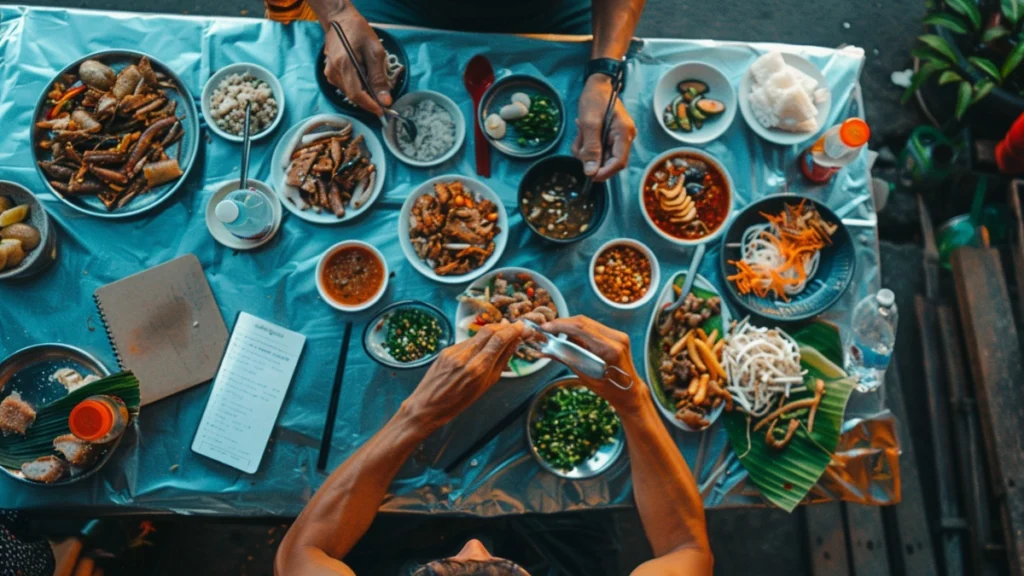
Budget-Friendly Travel Food Strategies: How I Eat Exceptionally Well on $15 a Day (Or Less)
The bowl of laksa cost me 8 Malaysian ringgit. That’s about $1.70 USD. I was sitting on a plastic stool in Penang’s Air Itam Market at 7:15 in the morning, sweat already forming on my forehead from the humidity and the chili-laced coconut broth steaming in front of me. The noodles were slippery rice vermicelli, the prawns were fresh enough that their shells still had that ocean-sweet smell, and the sambal on the side packed enough heat to clear my sinuses for the rest of the week. I’d eaten laksa at a well-reviewed restaurant in Singapore two days earlier for the equivalent of $14. It was fine. This one, from a woman named Ah Lian who’d been ladling soup since 4am, was transcendent.
I’ve been traveling and eating professionally for nearly a decade now. I’ve written for magazines that sent me to Michelin-starred restaurants in Tokyo and Copenhagen, places where a tasting menu costs more than some people’s monthly rent. And I’ll be honest with you: some of those meals changed how I think about food. But the experiences that shaped me most as an eater, the ones I return to in my memory when I’m sitting at my desk in Portland missing the road, are almost always the cheap ones. The $3 tacos al pastor in Mexico City. The $2 bánh mì in Saigon. The $4 plate of cacio e pepe at a Roman lunch counter where the owner yelled at me for asking for parmesan instead of pecorino.
This isn’t some romanticized notion that cheap automatically means better. That’s nonsense, and I’ve eaten enough bad street food to prove it. What I’ve learned after eating my way through 85 countries on budgets ranging from $10 to $200 a day is that price and quality have a much weaker relationship than most people assume. The correlation exists, sure, but it’s nowhere near as strong as the tourism industry wants you to believe. The real skill isn’t just finding cheap food. It’s finding cheap food that’s actually exceptional.
So let me share what I’ve figured out after a decade of obsessive note-taking, wrong turns, food poisoning (twice, both my fault), and thousands of meals eaten at plastic tables, market stalls, and hole-in-the-wall joints across six continents. This is everything I know about eating extraordinarily well without spending much money at all.
Table Of Contents
- The Fundamental Mindset Shift
- The Research Phase: 10 Hours That Save You Hundreds
- The Street Food Principle
- The Market Strategy
- Timing Is Everything
- The Neighborhood Strategy
- What to Splurge On, What to Save On
- Country-Specific Strategies
- Learning From Failures
- What Good Budget Eating Actually Looks Like
- The Real Value of Budget Eating
- Frequently Asked Questions
- How much should I budget for food per day while traveling?
- How do I avoid getting sick from street food?
- What's the best way to find good cheap food when I don't speak the local language?
- Can I eat budget food if I'm vegetarian or have dietary restrictions?
- Is street food safe for kids and families?
- What apps or tools do you use to find budget food while traveling?
- Learn About More Experiences
The Fundamental Mindset Shift
Before I get into tactics, I need to address something that took me years to fully internalize. When most travelers think about “budget food,” they’re thinking about compromise. They’re imagining sad sandwiches from convenience stores, skipped meals, or settling for whatever’s cheapest on the menu. That’s the wrong framework entirely.
Here’s the truth: in most of the world, the best food IS the cheap food. Not because poverty somehow creates better cooks, but because the economic incentives are completely different from what we’re used to in places like the US or Western Europe. In Bangkok or Lima or Marrakech, the most talented cooks often aren’t working in restaurants with tablecloths. They’re running stalls that have been in their families for generations, serving one dish or a handful of dishes that they’ve perfected over decades. Their rent is low or nonexistent. Their ingredients are sourced directly from the same markets where they cook. Their competition is fierce because there are dozens of other vendors selling similar food within walking distance.
This creates a quality pressure that most Western restaurants never face. When Somchai’s pad thai stall is right next to three other pad thai stalls at the same market, and they’re all charging between 40 and 60 baht, the only way he stays in business is by making his version better. The noodles have to be right. The wok hei has to be there. The tamarind and palm sugar have to hit that perfect sweet-sour balance. If he slips, customers walk ten feet to his competitor.
Compare that to a mid-range restaurant in, say, Chicago. They’re competing mostly on atmosphere, convenience, and marketing. The food needs to be good enough, but it doesn’t need to be exceptional because their customers are choosing them based on Yelp ratings, location, and whether the decor photographs well. The economic incentive for excellence is much weaker.
Once I understood this, budget eating stopped feeling like deprivation and started feeling like treasure hunting. The cheap food isn’t a consolation prize. It’s often the main event.
The Research Phase: 10 Hours That Save You Hundreds
I spend between 10 and 15 hours researching food before I visit any new city. Emma, my wife, thinks this is excessive. She’s probably right. But those hours consistently lead me to meals that cost a third of what tourists pay and taste twice as good.
Here’s what that research actually looks like. First, I ignore most English-language travel guides and websites. I’m not saying they’re all bad, but they tend to recommend the same 20 places that every other English speaker visits, and those places often raise prices or let quality slip once the tourist traffic becomes reliable. Instead, I start with local food blogs and social media. Google Translate has gotten good enough that I can read Thai food blogs or Spanish restaurant reviews with reasonable comprehension. The phrasing is awkward, but I can understand whether someone is enthusiastic or disappointed.
I look for patterns. If five different local bloggers mention the same noodle shop in Chiang Mai, that’s a stronger signal than one Western travel writer’s recommendation. I search Instagram and Xiaohongshu (the Chinese social platform) for location tags and see what dishes get photographed most. I join Facebook groups for expats and food enthusiasts in specific cities. These groups are gold mines because expats live there, they’ve tried dozens of places, and they have the context to distinguish between genuinely good food and tourist traps.
Google Maps reviews in the local language are another underused resource. Pull up a restaurant in Bangkok and toggle from English reviews to Thai reviews. You’ll often find completely different information. The English reviews might say “authentic and delicious!” while the Thai reviews mention that the portions shrunk last year or the original owner retired.
I also look at timing and crowd patterns. Street food stalls and market vendors often have limited hours, and those hours tell you something. A pho shop in Hanoi that closes at 10am isn’t just being eccentric. They’re operating during peak local demand (breakfast) and closing when the broth runs out. That’s usually a good sign. A restaurant that’s open from 11am to 11pm every day, serving the same hundred-item menu to whoever walks in? That’s a business model built for convenience, not for excellence.
By the time I land in a new city, I have a Google Maps folder with 40 to 60 pins, roughly prioritized by how excited I am to try each one. Maybe 30% of those pins will disappoint me. Maybe 10% will be closed or impossible to find. But the remaining 60% usually deliver, and the top 20% often become stories I tell for years.
The Street Food Principle
Let me be clear about something: street food is not automatically safe or good. I’ve gotten sick from street food twice in my life, both times from my own stupid mistakes. Once in Delhi, when I ate chaat from a vendor whose water supply I should have questioned. Once in Guatemala, when I ignored the warning signs of a slow-moving line and lukewarm meat. Street food requires judgment, the same as any other food.
But when you find street food vendors who are doing things right, they often represent the best value-to-quality ratio available anywhere in the food world. The reasons are simple: minimal overhead, maximum specialization, and direct customer feedback.
A great street food vendor typically makes one thing, or a small family of related things. They’ve made that thing thousands of times. The repetition creates mastery that generalist restaurants rarely achieve. When I eat tacos from a Mexico City street vendor who’s been flipping al pastor off the same trompo for 15 years, I’m getting the benefit of roughly 50,000 tacos worth of practice. That matters.
The overhead question is equally important. A vendor with a cart isn’t paying restaurant rent, insurance, or the salaries of servers, hosts, and managers. Those costs have to go somewhere in a traditional restaurant, and they usually go into your bill. When I pay $2 for street tacos, almost all of that $2 goes toward ingredients and the vendor’s labor. When I pay $15 for tacos at a sit-down restaurant, a significant portion is subsidizing the air conditioning, the playlist, and the Instagram-friendly murals on the walls.
Finding good street food requires paying attention to a few signals that I’ve learned to trust over the years. First, I watch local traffic. Not tourist traffic. Local traffic. If a noodle stall has a line of construction workers at 6:30am, that’s a strong endorsement. These aren’t people taking Instagram photos or checking TripAdvisor. They’re people who live here, who’ve tried the competition, and who are voting with their feet and their lunch money.
Second, I pay attention to turnover. High volume means fresh food. That pot of soup isn’t sitting around all day getting stale. Those noodles were cooked two minutes ago, not reheated from a batch made at dawn. When I see a vendor constantly working, taking orders, cooking, plating, taking more orders, I know the food is moving fast.
Third, I look for specialization. The stall that sells pad thai, pad see ew, drunken noodles, fried rice, curries, and spring rolls is a red flag. The stall that sells only khao man gai, the Thai version of chicken rice, is usually a safer bet. Specialization indicates that the vendor has chosen a niche and is trying to dominate it, rather than casting a wide net to catch whatever customers walk by.
Fourth, and this is the hardest thing to articulate, I’ve learned to read confidence in vendors. The best street food cooks I’ve encountered aren’t trying to convince you to eat their food. They know it’s good. They’ve got a certain economy of motion, a practiced indifference to the chaos around them. They’re not performing. They’re just cooking the way they’ve cooked ten thousand times before.
The Market Strategy
If street food is my love, food markets are my obsession. I’ve spent more hours wandering markets than any other single activity when I travel. Markets are where I understand how a place actually eats, what ingredients are in season, how much things cost, and who the serious food people are.
The first thing I do in any new city is find the central market, the one where locals actually shop for groceries. Not the cute tourist market with the souvenir shops and the expensive food court. The real one, where vegetables are piled on tables, where fish are being gutted on ice, where the noise is constant and the smells are strong. In Mexico City, that’s Mercado de la Merced. In Barcelona, it used to be La Boqueria, though that’s gotten too touristy. In Bangkok, it’s Or Tor Kor if you want quality, Khlong Toei if you want volume.
These markets almost always have food vendors mixed in with the produce sellers and the butchers. The food is cheap because the rent is shared, the ingredients are steps away, and the customer base is local. A fruit vendor making smoothies with the mangoes she couldn’t sell yesterday. A butcher’s wife grilling skewers of the cuts that didn’t move in the morning rush. A noodle soup stall tucked between a fish monger and a pile of fresh herbs.
I’ve learned to arrive at markets early. Not tourist early, like 9 or 10am. Actually early, like 6 or 7am, when the professionals are there. The restaurants buying ingredients for lunch service. The home cooks who want first pick. The vendors setting up and having their own breakfast before the rush. At that hour, I’m often the only foreigner, which used to make me self-conscious but now just means I get better service and more honest interactions.
Eating at markets has given me some of the best meals of my life at some of the lowest prices. A few that stick in my memory: a $2 plate of pad kra pao in Bangkok’s Chatuchak Weekend Market, so perfectly balanced that I went back four times during a single weekend. A $3 bowl of menudo at Mercado San Juan in Mexico City, served by a woman who’d been making it since before I was born. A 4 euro plate of cicchetti at Venice’s Rialto Market, eaten standing at a counter while watching the morning catch get sorted.
The market strategy also solves another budget travel problem: the grocery dilemma. When I’m staying somewhere with a kitchen, markets give me access to ingredients at local prices rather than tourist grocery store markups. I can buy fruit for breakfast, bread and cheese for lunch, and maybe a few vegetables to cook simply for dinner. The savings add up fast, and the quality is usually far better than anything wrapped in plastic at a supermarket.
Timing Is Everything
One of the most underrated budget eating strategies is simply understanding when locals eat and aligning your schedule accordingly. In much of the world, the same dish costs different amounts at different times of day, and the quality varies even more than the price.
Breakfast is almost always the best value. Morning eating traditions in most cultures developed around working people who needed fuel before labor. The food tends to be hearty, fast, and cheap. Vietnamese pho was originally a breakfast dish for laborers. Egyptian ful medames, those stewed fava beans I became obsessed with during a month in Cairo, is traditionally eaten before work. Mexican chilaquiles are a morning meal. These dishes often cost half what you’d pay for dinner at the same quality level.
I’ve restructured my entire eating day around this insight. When I travel, I eat my biggest meal at breakfast or mid-morning, when prices are lowest and quality is highest. I eat a lighter lunch, often just grazing at a market or grabbing something quick. Dinner is usually early, smaller, and sometimes just snacks and drinks. This pattern saves money, but more importantly, it aligns with how locals actually eat in most of the places I visit.
Lunch specials are another timing opportunity that travelers often miss. In countries with strong lunch traditions, from Japan to Italy to Peru, restaurants offer set menus at midday for far less than their evening prices. The food isn’t lesser quality. It’s the same kitchen making the same dishes, just at a time when competition from other lunch spots forces prices down.
I still remember the shock of discovering the pranzo (lunch) system in Italy. At a trattoria in Rome’s Testaccio neighborhood, I ate a three-course meal for 12 euros: pasta, a secondo of roasted chicken, and a quarter liter of house wine. The same dishes at dinner would have been easily 35 euros or more. The pasta was exceptional, real Roman cacio e pepe made by someone who’d been cooking it their entire adult life. The chicken had crispy skin and moist meat. I went back four days in a row.
Japan’s lunch culture is equally rewarding for budget eaters. The set lunch, called teishoku, typically includes a main dish, rice, miso soup, pickles, and sometimes a small salad or side. At a solid neighborhood restaurant in Tokyo, you’re looking at 800 to 1200 yen for food that would cost 2500 or more at dinner. Ramen shops, tonkatsu specialists, soba restaurants, they all participate in this lunch economy. I’ve had some of my best meals in Japan between 11:30am and 1pm, and I’ve rarely paid more than $10.
The Neighborhood Strategy
Here’s something I wish someone had told me earlier in my travels: the neighborhood where you stay matters more for food than almost any other factor. Not because of walkability, though that helps. But because tourist neighborhoods and local neighborhoods have completely different food economies.
I made this mistake badly on my first trip to Barcelona in 2013. I stayed in the Gothic Quarter because that’s what the guidebooks recommended. It’s beautiful, sure. But the restaurants in the Gothic Quarter are priced for tourists and optimized for turnover, not quality. I paid 15 euros for mediocre paella that was clearly made in huge batches and reheated. I paid 8 euros for sangria that was mostly ice and fruit with a splash of cheap wine.
On my second trip, I stayed in Poble Sec, a residential neighborhood about 20 minutes by metro from the tourist center. The transformation was immediate. The same quality paella, actually better quality, cost 9 euros at a neighborhood place where I was the only non-Catalan speaker. The vermouth bars served drinks for 3 euros instead of 8. The breakfast bakeries had locals reading newspapers and arguing about football, not tourists taking photos of their croissants.
This pattern repeats everywhere. In Mexico City, the Roma and Condesa neighborhoods are lovely but increasingly priced for expats and tourists. Move to Coyoacán or Narvarte, and your taco budget stretches twice as far with no sacrifice in quality. In Bangkok, Sukhumvit and Silom have international restaurants at international prices. Cross the river to Thonburi, and suddenly everything costs a third as much and tastes twice as real.
I now research neighborhoods as carefully as I research restaurants. I’m looking for places that have local residential life, not just hotels and Airbnbs. I want to see grandmothers walking to markets, kids going to school, workers grabbing breakfast before commuting. Those signals tell me the food economy hasn’t been distorted by tourism yet.
The tradeoff is convenience. Staying in local neighborhoods means you’re further from the famous sights. You might need to take more trains or taxis to see the things in your guidebook. But I’ve made peace with that exchange. The hours I save by not traveling to find good affordable food more than offset the extra transit time to museums or monuments.
What to Splurge On, What to Save On
Budget eating doesn’t mean never spending money. It means spending strategically, directing resources toward experiences that justify the cost and economizing on everything else. After years of trial and error, I’ve developed a rough framework for when to splurge and when to save.
I splurge on ingredients that are exceptional in a specific place and hard to find elsewhere. Sushi in Tokyo. Fresh seafood in coastal Portugal. Truffles in Piedmont during truffle season. Olive oil in Andalusia. These aren’t just items on a menu. They’re ingredients at the peak of their quality, in the place where that quality is most celebrated and most understood. The markup for quality is often smaller than you’d think, and the experience is irreplaceable.
I save on everything that’s a commodity. Plain coffee. Simple breakfasts. Basic starches. Beer. These things vary less in quality than their prices suggest, and the budget versions are usually perfectly acceptable. The 1 euro espresso at a neighborhood bar in Rome is 90% as good as the 4 euro espresso at a tourist cafe. The 20 baht bottle of water at a Bangkok 7-Eleven is identical to the 80 baht bottle at a hotel restaurant.
I splurge on experiences that provide education, not just calories. A cooking class with a local grandmother. A food tour led by someone who actually knows the city’s culinary history. A meal at a restaurant where the technique is genuinely innovative. These things cost more, but they pay returns in knowledge that compounds over every future meal.
I save on ambiance and save on service. Restaurants charge significant premiums for tablecloths, views, attentive waiters, and beautiful plating. Those premiums often have little connection to food quality. I’ve had mediocre meals in stunning rooms and transcendent meals in places with fluorescent lighting and plastic chairs. Given the choice, I’ll take good food in an ugly room every time.
I also think about splurging strategically within meals. At a great restaurant, I’ll order the dish they’re known for and skip the generic sides. At a street market, I’ll buy the thing that’s clearly made with care and ignore the mass-produced snacks next to it. You don’t have to splurge on everything. You just have to splurge on the right things.
Country-Specific Strategies
Every country has its own budget eating logic. The patterns that work in Thailand don’t apply in France. The tactics for Japan differ from those for Mexico. Over the years, I’ve built up a mental database of country-specific approaches. Let me share a few.
In Southeast Asia, particularly Thailand, Vietnam, Malaysia, and Indonesia, street food is the primary budget strategy, but there’s nuance within that. The cheapest meals are almost always rice-based. A plate of khao man gai in Thailand or com tam in Vietnam gives you a complete protein-carb-vegetable meal for $1 to $2. Noodle dishes tend to cost 20 to 30 percent more but are still remarkably cheap. Anything marketed specifically to tourists, even if it’s technically “street food,” often costs three to four times the local price.
I’ve learned to use convenience stores strategically in these countries. 7-Elevens in Thailand and Vietnam stock surprisingly good prepared foods: decent sausages, rice dishes, fresh fruit cups. When I’m exhausted and don’t want to navigate a market, a convenience store meal for $2 to $3 is perfectly acceptable.
Mexico operates on a different logic. Breakfast and lunch are where the value concentrates. A real Mexican breakfast, huevos rancheros or chilaquiles with beans, rice, and fresh tortillas, typically costs 80 to 120 pesos at a local fonda. That’s $4 to $6 for a meal that will carry you until late afternoon. Tacos are the obvious budget choice, but I’ve found even better value in mercado food courts, where a plate of mole with rice and tortillas costs as much as four street tacos but provides twice the satisfaction.
The evening is trickier in Mexico. Sit-down restaurants get expensive quickly, especially in tourist areas. My solution is to eat a big late lunch, around 3 or 4pm, and then graze on street food in the evening. Elotes, tostadas, tamales, fruit cups. You can eat well for $3 to $5 this way while experiencing the evening street culture.
Japan surprised me. The reputation for expense is real if you’re eating at restaurants in Tokyo’s tourist districts or ordering fancy sushi. But the country also has an incredibly robust cheap eating infrastructure that most visitors never discover. Conveyor belt sushi can be excellent at places like Sushiro or Kura Sushi, with plates starting at 100 yen. The standing noodle shops in train stations serve solid udon and soba for 300 to 500 yen. Supermarkets discount their prepared foods dramatically after 7pm, including sushi that was made that morning.
I’ve eaten some of my best ramen in Japan at places where the bill never exceeded 1000 yen. The trick is to look for the small, crowded shops in residential neighborhoods, not the famous ones with hour-long lines. A fantastic bowl of tonkotsu at a no-name shop in Osaka’s Shin-Osaka area cost me 780 yen last year. It was rich, porky, with perfectly chewy noodles. No English menu, no tourists, just salary workers slurping soup before catching their trains.
Italy requires patience and timing. The tourist infrastructure is so developed that you can easily spend $30 on a mediocre meal if you’re not careful. But the pranzo system I mentioned earlier is transformative. So is aperitivo, the early evening ritual where bars serve free food with drink purchases. For the cost of a 6 to 8 euro spritz, you often get access to a spread of olives, bread, cheese, salumi, and small bites. It’s not a complete meal, but combined with a few more drinks, it can substitute for dinner.
The markets in Italy remain relatively affordable even as restaurant prices climb. I’ve eaten wonderful suppli, those fried rice balls, at Rome’s Testaccio Market for 2 to 3 euros each. Fresh pasta from a Bologna market, cooked at my rental apartment, cost less than a McDonald’s meal. Sliced porchetta on good bread at Orvieto’s Thursday market might be the best sandwich value in Western Europe.
Learning From Failures
I’ve made every budget eating mistake you can imagine. I’ve trusted hotel concierges who sent me to their cousin’s overpriced restaurant. I’ve followed TripAdvisor rankings to places that were good three years ago and have since declined. I’ve walked past incredible street stalls because they didn’t look clean enough, only to learn later that they were locally famous. I’ve paid tourist prices because I was tired and didn’t feel like walking another 15 minutes.
The worst budget eating mistake I ever made was in Paris, during my first solo trip in 2011. I was intimidated by the language barrier and the reputation for Parisian coldness. So I ate at the obvious places near my hotel in the Marais, the ones with English menus posted outside. I spent probably $150 over three days on forgettable meals: mediocre croque monsieurs, limp salads, overpriced wine. When I finally worked up the courage to venture to a neighborhood bistro in the 11th arrondissement, I ate a stunning three-course lunch for 14 euros and realized I’d been a coward for three days.
That experience taught me something important. The fear of awkwardness or confusion often costs more than money. It costs you the experiences you came traveling for. These days, I walk into places where I don’t speak the language, point at what other people are eating, use translation apps, and generally make a fool of myself. The discomfort lasts five minutes. The memories of good meals last forever.
I’ve also learned that my standards need to flex based on context. What’s good in Bangkok might be merely okay in Los Angeles. What’s exceptional in rural Mexico might be ordinary in Mexico City. Budget eating requires calibrating your expectations to place, understanding what’s possible here and aiming for that, rather than comparing everything to some abstract ideal.
The most useful failure might have been getting food poisoning in Guatemala. I was traveling through Antigua, eating at street stalls every day, getting cocky about my iron stomach. I ignored warning signs at a pupusa vendor: slow line, meat sitting at room temperature, no visible heat source. The next 36 hours were miserable. But I learned to pay attention to hygiene signals, to trust my instincts when something looks off, and to remember that “cheap” shouldn’t mean “reckless.”
What Good Budget Eating Actually Looks Like
Let me give you a concrete example of what a good budget eating day looks like in practice. This is from my notes during a recent trip to Penang, Malaysia.
I woke up at 6am, walked 15 minutes from my guesthouse in George Town to a kopitiam, one of those traditional coffee shops, that I’d found through a local food blogger. Ordered kaya toast with soft-boiled eggs and a strong kopi for 6 ringgit total, about $1.30. The toast was made with thick Hainanese-style bread, charred over a fire, spread with coconut jam and cold butter. The coffee was brewed in a cloth sock filter, strong enough to vibrate my eyeballs. Perfect.
Mid-morning, around 9:30, I took a bus to the Chowrasta Market. Spent an hour wandering, photographing vegetables I didn’t recognize, watching the chaos of the morning rush. At a stall in the corner, I bought a bag of pisang goreng, fried bananas, for 2 ringgit. They were hot from the oil, crispy outside, creamy inside. I ate them standing next to a pile of durian, which I still can’t bring myself to like despite trying it in four countries.
Lunch was at a hawker center called New World Park. I’d read about a char kway teow stall here run by a woman who’d been cooking the dish for 30 years. The line was 10 people deep when I arrived at 11:45. I waited about 15 minutes. The noodles cost 8 ringgit, roughly $1.70. They were extraordinary: smoky from the wok, slightly chewy, studded with cockles and Chinese sausage and bean sprouts. The eggs were cooked in at the last second, creating little pockets of custardy richness throughout. I ordered a second plate.
Afternoon, I walked through George Town’s streets, exploring temples and murals. Stopped at a juice stall for fresh watermelon juice, 3 ringgit. Later, found a vendor selling apom, these lacy coconut pancakes, for 1 ringgit each. Ate two while watching the traffic.
Dinner was at a seafood hawker center called Auto City. Emma and I ordered grilled stingray with sambal, fried morning glory, and fried rice. Total bill for both of us: 45 ringgit, about $10. The stingray was blackened and smoky, the sambal fermented and funky. We drank Tiger beers for 8 ringgit each and watched families having their weekend dinners at the tables around us.
Total food spend for the day: approximately 85 ringgit, or about $18 USD. I ate six times, never felt hungry, had multiple genuinely excellent meals, and spent more time thinking about what to eat next than worrying about the cost.
The Real Value of Budget Eating
I want to end with something that might sound strange coming from someone who’s written thousands of words about how to eat cheaply. Budget eating isn’t really about the money. I mean, it is. It’s nice to travel longer because you’re not spending $100 a day on food. It’s nice to feel smart about your choices, to get exceptional value.
But the deeper value is access. When you eat where locals eat, at the prices locals pay, you see things tourists don’t see. You have conversations that don’t happen in tourist restaurants. You understand a place’s food culture in a way that’s impossible when you’re experiencing the version curated for visitors.
Some of my most meaningful travel moments have happened over cheap meals. The grandmother in Hanoi who taught me how to properly add herbs to my pho. The taco vendor in Oaxaca who explained the regional differences in mole while I ate at his stall. The Italian butcher who gave me an impromptu lesson on pork cuts when I pointed at something I didn’t recognize. These encounters happened because I was in places where locals gather, not in places designed to extract money from tourists.
Budget eating also creates a certain kind of attention. When you’re researching and seeking and evaluating, you’re engaged with food in a way that expensive restaurants don’t require. You’re thinking about why this vendor is good, what makes this dish work, how the ingredients come together. That attention enriches the experience regardless of price.
I’ve eaten meals that cost $500. Some of them were genuinely remarkable, experiences I’ll remember forever. But I’ve also eaten meals that cost $5 that I remember just as vividly. The price didn’t determine the meaning. The attention did. The curiosity did. The willingness to seek out something genuine instead of settling for something convenient.
That’s what I’d encourage you to take from all of this. Yes, you can save hundreds of dollars by eating strategically. Yes, street food and markets and local neighborhoods offer better value than tourist restaurants. But the real gift of budget eating is the way it forces you to engage, to research, to pay attention, to be present. That’s worth more than any amount of money you save.
Now go find the noodle shop in your next destination that the locals won’t shut up about. Ask for the dish that doesn’t have an English translation. Sit on the plastic stool and eat your $2 meal and watch the city move around you. That’s where the good stuff is. It’s always been there, waiting for you to notice.
Frequently Asked Questions
How much should I budget for food per day while traveling?
This varies wildly by destination, but here’s what I’ve found after tracking expenses across dozens of trips. In Southeast Asia, including Thailand, Vietnam, Malaysia, and Indonesia, you can eat extremely well on $10 to $15 per day. Mexico runs about $15 to $20 for three solid meals plus snacks. Japan, despite its reputation, is manageable at $25 to $35 if you use the strategies I’ve outlined. Western Europe is trickier, but $30 to $40 is doable if you lean heavily on markets, lunch specials, and aperitivo culture. I always budget separately for one or two splurge meals per trip, usually $50 to $100 each, so I can experience something special without blowing my daily average.
How do I avoid getting sick from street food?
I’ve eaten street food in over 60 countries and gotten sick exactly twice, both times from ignoring obvious warning signs. The key is watching for high turnover, meaning food that’s being cooked fresh and served immediately rather than sitting around. Look for vendors with steady lines of local customers. Check that meat is cooked to order and served hot. Avoid raw vegetables and salads at stalls where you can’t see how they’re washed. Skip any vendor where the cooking area looks grimy or where food sits uncovered attracting flies. Trust your instincts. If something feels off about a stall, walk away. Your gut, literally, will thank you.
What’s the best way to find good cheap food when I don’t speak the local language?
Point and smile. Seriously, that gets you 80% of the way there. I also use Google Translates camera feature to read menus and signs. Before I travel, I learn three phrases in the local language: “this one please” while pointing, “how much,” and “thank you.” Beyond that, I watch what locals are ordering and point at their plates. Most vendors are patient with foreigners who are genuinely trying. I’ve also found that showing a photo of a dish on my phone works surprisingly well. The language barrier feels scary before you try, but food is universal enough that you figure it out fast.
Can I eat budget food if I’m vegetarian or have dietary restrictions?
Yes, though it requires more research and some destinations are easier than others. India is paradise for vegetarian budget eating. Southeast Asia has abundant vegetarian options, especially at Buddhist restaurants in Thailand and Vietnam, though fish sauce sneaks into many dishes so you need to ask. Mexico is trickier because lard shows up in unexpected places, but markets always have vegetable-heavy options. For allergies, I carry a translated card explaining my restrictions, which I found through apps like Google Translate or websites that offer food allergy cards in multiple languages. I also research specific dishes that are naturally free of my allergens rather than trying to modify dishes on the fly.
Is street food safe for kids and families?
My friends who travel with children have found that street food works fine with a few adjustments. Stick to cooked foods served hot. Avoid ice in drinks unless you’re confident about the water source. Choose vendors where you can watch the cooking process. Start with mild dishes and familiar proteins until kids adjust to new cuisines. Many street food cultures actually cater well to children because the portions are small, the flavors can be adjusted, and kids can see exactly what they’re getting before committing. The plastic stools might be low, but I’ve watched plenty of Thai and Vietnamese families eating with toddlers at hawker centers. If locals bring their kids, it’s generally a good sign.
What apps or tools do you use to find budget food while traveling?
Google Maps is my primary tool, but I use it differently than most people. I search in the local language, read reviews from locals rather than tourists, and look for places with lots of reviews but moderate ratings, usually 4.0 to 4.3 stars, since the absolute highest-rated places often become tourist traps. I use Instagram and Xiao hong shu to search location tags and see what dishes locals photograph. Facebook groups for expats in specific cities are goldmines for honest recommendations. Happy Cow is essential for finding vegetarian options. For real-time translation of menus and signs, Google Translates camera feature has saved me countless times. I keep a simple spreadsheet of places I want to try, organized by neighborhood, so I’m never wandering hungry without a plan.