
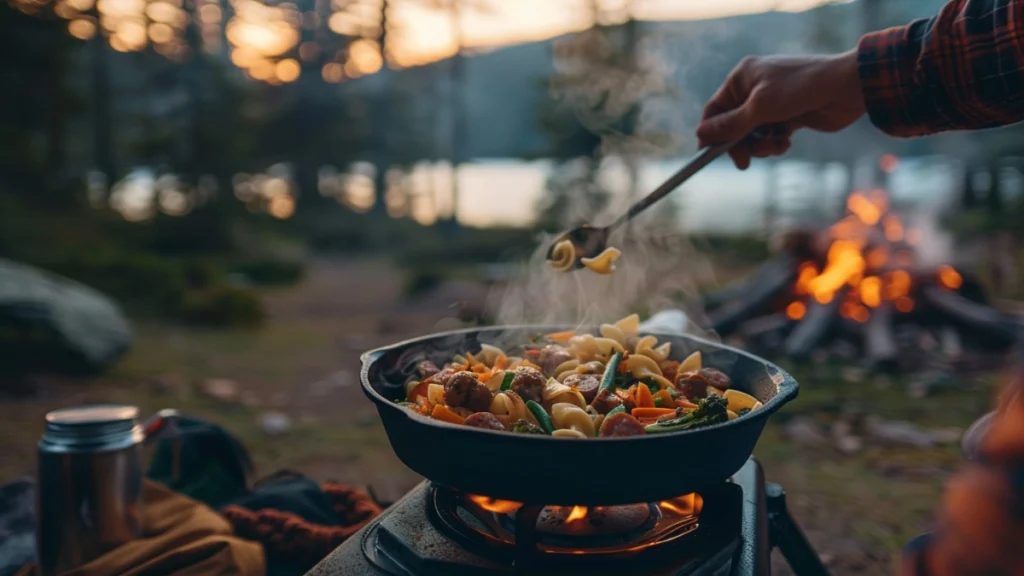
Simple One-Pot Camping Dinners: The Art of Minimizing Cleanup Without Sacrificing Flavor
The moment I realized I had been doing camp dinners all wrong happened at a remote site in Oregon’s Three Sisters Wilderness, about six miles from any trailhead. It was September 2021, and I had just finished cooking what I thought was an impressive backcountry meal: seared chicken, sautéed vegetables, and a separate pot of rice. Marcus sat across from me, watching with that particular expression he gets when he’s about to deliver uncomfortable feedback. “That was really good,” he said slowly, “but you’ve been scrubbing pots for twenty minutes, we’re losing daylight, and I’m pretty sure a squirrel just made off with the rest of the bread.” He was right on all three counts. I had three dirty containers, a headlamp battery that was already dying, and a bold rodent who had exploited my distraction.
That evening fundamentally changed how I approach camp cooking. In the four years since, I have designed, tested, failed at, and eventually perfected over 40 one-pot dinner recipes specifically for camping. My criteria are rigid: everything must cook in a single vessel, the total active cooking time cannot exceed 25 minutes, and the final result has to taste good enough that my perpetually honest camping partners would actually request it again. These recipes have traveled with me across 14 different states, from sea level beach camps to alpine sites above 11,000 feet, and they have been stress-tested in conditions ranging from perfect calm evenings to that memorable night in the Wind River Range when the temperature dropped to 18 degrees and my hands were too cold to manage anything complicated.
The philosophy behind one-pot cooking extends beyond mere convenience, though the convenience is substantial. When you cook everything in a single pot, skillet, or pan, you reduce your pack weight since you’re carrying less gear, you conserve water because there’s less to clean, you save fuel by not running multiple burners or reheating, and you spend more time actually enjoying the wilderness instead of playing dishwasher. My friend Jake, who photographs landscapes and therefore has opinions about optimal light conditions, once calculated that my one-pot dinners saved us an average of 35 minutes per evening compared to my previous multi-vessel approach. That’s 35 extra minutes of sunset, of conversation, of simply existing in a beautiful place without obligations.
Table Of Contents
- Understanding the One-Pot Mindset
- My Workhorse Recipe: The Everything Skillet
- The Backcountry Pasta Solution
- Mastering the Camping Curry
- The Critical Role of Mise en Place
- Addressing Altitude and Weather Challenges
- Cleanup Strategies That Actually Work
- Recipes That Have Earned Permanent Rotation
- What I'm Still Working On
- The Deeper Value of Simple Cooking
- Closing Thoughts and Next Steps
Understanding the One-Pot Mindset
Before I share specific recipes, I want to explain the thinking process that makes one-pot camping dinners work. This isn’t about cramming everything into a container and hoping for the best. It’s about understanding layering, timing, and the specific properties of your cooking vessel.
The first principle involves cooking sequence. Every ingredient has an ideal cooking time, and the secret to a successful one-pot meal lies in adding components in the right order. Dense vegetables like carrots and potatoes go in first. Proteins typically follow. Quick-cooking items like leafy greens or pre-cooked grains enter last. I learned this through a spectacular failure at a campsite near Crater Lake in 2019, when I added everything simultaneously and ended up with raw potatoes floating in a sea of disintegrated spinach. The potatoes needed 15 minutes. The spinach needed 90 seconds. My attempt to split the difference satisfied no one.
The second principle concerns liquid management. Most one-pot meals rely on some amount of liquid, whether that’s broth, water, coconut milk, or tomato sauce. Getting the quantity right matters enormously. Too much liquid and you have soup when you wanted stew. Too little and everything burns or cooks unevenly. Through extensive testing, I’ve found that starting with slightly less liquid than you think you need almost always works better than starting with more. You can add liquid during cooking, but you cannot take it away without extending your cooking time and complicating cleanup.
The third principle is what I call strategic deglazing. When you cook proteins or vegetables that release sugars and fats, those compounds stick to your cooking surface and caramelize. This is called fond, and it contains tremendous flavor. Rather than viewing this as a cleaning problem, I treat it as a flavor resource. Adding a splash of liquid after the initial sear lifts that fond into your dish. This technique transforms a potential scrubbing challenge into a taste enhancement, and it happens to be one of the easiest ways to make camp food taste closer to home cooking.
My Workhorse Recipe: The Everything Skillet
If I had to choose one recipe that exemplifies successful one-pot camping, it would be what I’ve come to call the Everything Skillet. I have made this meal 27 times across trips spanning three years, and it has never failed me. The basic concept involves cooking a protein, a starch, and vegetables together in a single cast iron or nonstick pan, finishing with a sauce that brings cohesion.
For a serving of two, you will need about 12 ounces of protein cut into bite-sized pieces, two cups of quick-cooking vegetables chopped to similar sizes, one cup of instant rice or couscous, approximately two cups of liquid, and whatever seasoning blend you prefer. I prep almost everything at home, storing the protein in one freezer bag and the pre-mixed vegetables and seasonings in another. The only thing I measure at camp is the liquid.
The cooking process follows a strict sequence that takes 22 minutes from start to finish based on my timing across multiple attempts. Start by heating your pan over medium-high heat for about 90 seconds. Add a tablespoon of oil and let it shimmer. Add your protein and do not touch it for three full minutes. I know this is difficult because I have violated this rule dozens of times, usually because I got anxious or distracted, and the result is always inferior. After three minutes, stir once and cook for another two minutes. Remove the protein to a plate or the lid of your pot. Add another splash of oil if needed, then add your vegetables. Cook for five minutes, stirring occasionally. Add your grain and liquid, bring to a simmer, cover, and cook for eight minutes without lifting the lid. Return the protein to the pan, stir everything together, and let it rest for two minutes before eating.
This template adapts to virtually any combination of ingredients. My personal favorite version uses Italian sausage crumbled into chunks, zucchini and bell peppers, instant couscous, chicken broth, and a blend of oregano, basil, and garlic powder that I mix at home and store in a small plastic container. Marcus has requested this specific combination at least 15 times, which is the highest compliment he offers. Sarah, who is vegetarian, makes a version with chickpeas and cubed sweet potatoes that cooks in the same amount of time if she cuts the sweet potatoes small enough, roughly half-inch cubes.
The Backcountry Pasta Solution
Pasta presents unique challenges for one-pot camping cooking. Traditional pasta preparation involves boiling in a large volume of water, draining, and then combining with a separate sauce. That approach requires multiple steps, substantial water usage, and at minimum two pots. I spent nearly two years developing a single-pot pasta method that works reliably at elevations up to 10,000 feet, uses minimal water, and produces results that genuinely taste good rather than merely acceptable.
The technique I landed on involves cooking the pasta in the sauce itself, a method that home cooks call “one-pot pasta” but that requires significant modification for camp conditions. The key insight came during a trip to the San Juan Mountains in Colorado, when I was cooking at about 9,500 feet and standard pasta techniques were taking forever because water boils at lower temperatures at altitude. I had brought more sauce than usual due to a packing error, and in frustration I simply dumped the pasta directly into the sauce with some extra water. The result was better than anything I had made using conventional methods.
My current version works like this. In a pot that holds at least three quarts, combine one pound of short pasta like penne or rotini, one jar or 24 ounces of marinara sauce, and two cups of water. I use jarred sauce because it travels well and the flavor is consistent. Place this over medium heat, stir well to separate the pasta, bring to a simmer, then reduce heat to medium-low and cook for 14 to 16 minutes, stirring every two to three minutes to prevent sticking. The pasta absorbs the liquid as it cooks, and the starch it releases thickens the sauce. By the time the pasta is tender, the sauce should coat it naturally without requiring draining.
I tested this recipe at sea level in Washington state, at 5,000 feet in central Oregon, and at 9,500 feet in Colorado. The cooking time varied by about three minutes across these elevations, with higher elevations requiring more time. At sea level, 14 minutes produced perfectly al dente pasta. At 9,500 feet, I needed closer to 17 minutes, and the pasta was slightly softer than ideal but still completely acceptable.
To make this into a more complete meal, I add protein during the cooking process. Sliced Italian sausage goes in at the beginning along with everything else. Cubed chicken should be seared first in the dry pot, removed, and returned during the last five minutes of cooking. Pre-cooked meatballs can be added directly from frozen and will heat through during the simmering time. I have also made a version with white beans and spinach for Sarah that she declared “genuinely restaurant quality,” though I suspect she was being generous.
Mastering the Camping Curry
Curry represents perhaps the ideal one-pot camping meal. The genre naturally combines protein, vegetables, and sauce in a single vessel. The flavors improve as ingredients mingle. And curry powder masks a multitude of potential mistakes, which is useful when you’re cooking by headlamp after a long day on the trail.
My go-to camping curry evolved from a recipe I learned while working as a trail crew cook in the North Cascades during my mid-twenties. We had to feed 12 teenagers nutritious meals using limited equipment, and curry became a weekly staple because it satisfied vegetarians and meat-eaters simultaneously, scaled easily, and cleaned up with minimal effort. The version I make now bears only passing resemblance to that original recipe, but the core principle remains: build flavor in layers, let everything simmer together, and trust the process.
For four generous servings, which feeds two very hungry people or three moderately hungry ones, I use one can of full-fat coconut milk, one cup of water, three tablespoons of your preferred curry paste or two tablespoons of curry powder, one pound of protein cut into pieces, about four cups of chopped vegetables, and salt to taste. I prep the vegetables and mix the curry paste with a splash of water at home to create a slurry that incorporates more easily at camp.
The cooking method starts with searing your protein in a bit of oil until browned on the outside, which takes about four minutes total. Remove the protein and set aside. Add your hardest vegetables, meaning potatoes, carrots, or winter squash, and cook for three minutes. Add the curry paste slurry and stir for one minute until fragrant. Add the coconut milk and water, bring to a simmer, and cook covered for eight minutes. Add softer vegetables like bell peppers, zucchini, or green beans, return the protein to the pot, and simmer for another eight minutes. The whole process takes about 25 minutes from cold pot to finished curry.
I have made variations of this curry at least 30 times over the past three years. The most successful version used chicken thighs, sweet potato chunks, bell peppers, and red curry paste, finished with a squeeze of lime juice that I carried in a small plastic squeeze bottle. The least successful involved an ill-advised experiment with tofu that fell apart completely because I failed to press it adequately before the trip. Luna tried to eat the resulting mess, which tells you something about either its appeal or her standards.
The Critical Role of Mise en Place
Professional chefs use a French term, mise en place, meaning “everything in its place.” The concept involves preparing and organizing all ingredients before cooking begins. In a home kitchen, this is good practice. In a camp setting, it is absolutely essential for successful one-pot cooking.
My pre-trip preparation routine has become almost ritualistic. Two days before departure, I plan every meal and create a master ingredient list. One day before, I prep everything that can be prepped: chopping vegetables, mixing spice blends, measuring dried ingredients into labeled bags. I use a color-coding system that took me years to perfect, with blue bags for breakfast components, red for dinner, and green for snacks and sides. Each dinner bag contains everything needed for that specific meal except perishable proteins, which travel in my cooler in flat-frozen packages that stack efficiently.
This level of preparation might seem excessive, but it has saved me countless times. At a campsite in Glacier National Park, a sudden rainstorm forced us to cook under a hastily arranged tarp with water dripping inches from our stove. Because every ingredient was pre-measured and organized, I completed dinner prep in six minutes instead of the usual 15. At a site in Utah where wind gusted to 40 miles per hour, having everything sealed in bags prevented the seasoning catastrophe that had plagued an earlier trip when I lost half my salt supply to an unexpected gust.
The other benefit of thorough mise en place is that it allows you to modify recipes based on conditions. If you’re exhausted after a 15-mile day, you can assess your pre-portioned ingredients and choose the simplest option. If you’re feeling ambitious and the weather cooperates, you can attempt something more elaborate. This flexibility requires planning, but the planning happens at home where you have access to measuring cups, a cutting board, and a refrigerator for proper food storage.
Addressing Altitude and Weather Challenges
Anyone who has cooked above 8,000 feet knows that altitude changes everything. Water boils at lower temperatures as elevation increases, which means food takes longer to cook even when your pot is bubbling vigorously. At 10,000 feet, water boils at about 194 degrees Fahrenheit instead of the standard 212, and that 18-degree difference affects cooking times dramatically.
I have spent three summers in Colorado above 10,000 feet and countless nights at various elevations throughout the Western mountains. Through this experience, I have developed adjustment guidelines that I apply to all my one-pot recipes. For every 1,000 feet above 5,000 feet of elevation, I add approximately one minute to any cooking process that involves simmering or boiling. This means a recipe that takes 15 minutes at sea level might need 20 minutes at 10,000 feet. These numbers are not precise because humidity, pot thickness, stove output, and wind exposure all influence cooking times, but they provide a useful starting point.
Cold weather creates different challenges. In temperatures below freezing, your fuel efficiency drops because the gas in canister stoves struggles to vaporize. Everything takes longer to heat, and food cools rapidly once removed from the flame. During a winter camping trip in the Oregon Cascades when overnight temperatures hit 5 degrees Fahrenheit, I learned to keep my fuel canister warm inside my jacket, to pre-heat my cooking water on the stove lid while eating appetizers, and to eat directly from the cooking pot rather than transferring to bowls that would accelerate cooling.
These environmental adjustments have become second nature, but they required significant trial and error. My most spectacular failure involved frozen broth cubes that I had intended to use for a one-pot rice dish. The temperature dropped unexpectedly overnight in the Wind River Range, and my beautifully frozen flat packs of broth had become solid blocks that would not fit in my pot. I ended up making a much less flavorful version with plain water while Marcus offered observations about the importance of contingency planning. He was not wrong, though his timing could have been better.
Cleanup Strategies That Actually Work
The entire point of one-pot cooking is minimizing cleanup, but “minimizing” does not mean “eliminating.” Even the most efficiently designed recipe leaves you with at least one dirty vessel, and cleaning that vessel properly matters for food safety, equipment longevity, and Leave No Trace ethics.
My cleanup system involves four steps that I follow without exception. First, I wipe the pot with a paper towel while it is still warm, removing any remaining food particles before they harden. Second, I add a small amount of water, about half a cup, and bring it to a simmer to loosen anything stuck to the surface. This deglazing step works with the same principle I mentioned earlier, except now I’m using it for cleaning instead of flavoring. Third, I scrub with a small mesh pad that lives in a plastic bag with my cooking gear. Fourth, I sanitize with a few drops of unscented castile soap and rinse thoroughly.
The key insight is that hot water and mechanical action accomplish more than soap alone. Many camping recipes suggest elaborate cleaning procedures or specialized products, but I have found that immediate attention plus heat handles most situations effectively. The exception is baked-on cheese or sugary sauces, which require soaking. For these situations, I fill the pot with water after eating and let it sit while we enjoy the evening. By the time I’m ready to clean, most residue has loosened.
For disposal, I follow Leave No Trace guidelines religiously. Strained food particles get packed out with our trash. Wash water gets dispersed at least 200 feet from any water source, away from trails and campsites. I carry a small collapsible strainer specifically for this purpose, and I have lectured more than a few fellow campers about proper greywater disposal. The wilderness is not a sink, and one-pot cooking is not an excuse for environmental carelessness.
Recipes That Have Earned Permanent Rotation
After years of testing and refinement, certain recipes have earned permanent places in my camping repertoire. These are the meals I return to repeatedly because they deliver consistent results, adapt well to available ingredients, and generate genuine enthusiasm from my camping partners.
The campfire mac and cheese took me nine attempts to perfect and remains one of the most requested meals in my collection. The technique involves cooking elbow pasta directly in a mixture of one can of evaporated milk and one cup of water, then stirring in pre-shredded sharp cheddar off the heat until melted. The evaporated milk is shelf-stable, packs flat, and creates a creaminess that regular milk cannot achieve. I add crumbled bacon that I cook and crumble at home, storing it in a freezer bag where it keeps for three days in a cooler. Marcus calls this “better than the boxed kind,” which from him constitutes a rave review.
My sausage and white bean stew works particularly well in cool weather because it is warming, protein-rich, and comes together in about 18 minutes. I brown sliced kielbasa or andouille sausage first, then add diced onion and cook until softened. Two cans of drained white beans go in next, followed by one can of diced tomatoes, a cup of chicken broth, and a generous amount of Italian seasoning. The mixture simmers until everything is heated through and the flavors have merged. I sometimes add a handful of spinach during the last two minutes, watching it wilt into the stew. This recipe scaled beautifully when I made it for a group of eight during a car camping trip to the Oregon coast. I simply used my larger Dutch oven and doubled everything.
The peanut noodle bowl emerged from a camping trip with Sarah, who challenged me to create something flavorful that contained no animal products. Ramen noodles cook in about three minutes in boiling water. While they cook, I whisk together peanut butter, soy sauce, a splash of rice vinegar, and a pinch of chili flakes in a separate container. Once the noodles are done, I drain them, return them to the pot off the heat, add the sauce, and toss to combine. Shredded cabbage and grated carrots mixed in at the end add crunch and nutrition. Sarah has made this recipe independently at least a dozen times since I taught her the technique, which I consider the highest form of validation.
What I’m Still Working On
Honest writing about cooking requires acknowledging ongoing challenges. Despite my years of experience, certain one-pot preparations still elude me.
Camp pizza remains my white whale. I have attempted various approaches including cast iron deep dish, skillet flatbread topped after cooking, and something involving a pot lid as an improvised pizza stone. None have produced results I would serve to anyone other than myself after a very long day when standards had collapsed. The crust either burns or stays doughy in the center, the cheese melts unevenly, and the process generates more cleanup than a conventional one-pot meal. I remain determined to crack this code eventually, but I cannot in good conscience recommend any of my current attempts.
Rice presents consistent difficulties above 8,000 feet. The timing becomes unpredictable, and even with careful lid management and temperature control, I regularly produce either crunchy or gummy results. My workaround involves using instant rice, which sacrifices some texture and flavor but delivers reliable outcomes. Regular rice cooked at altitude remains an unsolved problem in my repertoire.
Fish is tricky in one-pot applications because it cooks quickly and falls apart easily. My experiments with salmon in curry-style preparations have produced acceptable but not exceptional results. The fish tends to break into small flakes rather than remaining in attractive pieces, which does not affect taste but diminishes visual appeal. I am currently testing a method that involves cooking the fish separately in foil packets over the same flame, but this somewhat defeats the single-vessel philosophy.
The Deeper Value of Simple Cooking
Beyond practical concerns about cleanup and efficiency, one-pot camping dinners carry philosophical weight that I have come to appreciate more deeply as my years in the outdoors accumulate.
There is something fundamentally satisfying about producing a complete, nourishing meal from a single vessel. The constraint forces creativity within boundaries, much like a sonnet’s 14 lines create space for poetic invention. When I cook at camp now, I experience a kind of flow state that eluded me during my earlier, more complicated cooking attempts. The process feels integrated rather than fragmented.
The shared experience of eating from a common pot, or at least a pot that represented a unified cooking effort, also builds connection among camping partners. Jake, who initially complained about any time spent on camp cooking, has become genuinely interested in the process. He now asks questions about why I’m adding ingredients in a particular order, and he has started suggesting variations based on foods he enjoys at home. That engagement would not have developed if I were spending 45 minutes managing multiple pots while he sat waiting impatiently for the “good light” to arrive.
My camping food journal, which I have maintained since 2017, contains entries from over 180 recipe tests conducted in wilderness settings. Reviewing those pages reminds me how far my skills have progressed and how much I still have to learn. The early entries are full of disasters: burnt rice, underseasoned stews, proteins that were pink in the center. The recent entries are more confident but still contain honest assessments of what did not work. I burned garlic as recently as last July at a site near Crater Lake, marking that incident as number 44 in my running tally. Improvement comes through practice, but perfection remains perpetually out of reach.
Closing Thoughts and Next Steps
Writing about one-pot camping dinners has forced me to articulate principles that I had absorbed intuitively through years of practice. The process of explaining these techniques to readers who might be new to outdoor cooking has clarified my own understanding and revealed assumptions that needed examination.
If you are beginning your one-pot camping journey, I encourage starting with the Everything Skillet template I described earlier. Master that basic framework before attempting more ambitious preparations. Pay attention to cooking sequence, manage your liquids carefully, and embrace the strategic deglaze. Prepare obsessively at home so that camp cooking becomes assembly rather than creation.
Your first attempts will likely disappoint. I still remember my Great Oatmeal Incident of 2018 on Washington’s Olympic Peninsula, when I produced breakfast so terrible that my entire group refused to eat it. That failure taught me more about one-pot breakfast cooking than any success had, and the lessons learned became foundations for better techniques.
Marcus and I have a trip planned for next month in the North Cascades, where I intend to test three new one-pot recipes that I have been developing since fall. One involves a coconut curry with shrimp that I think will work brilliantly if I can solve the timing challenge of getting the shrimp perfectly cooked without overcooking the vegetables. Another is a modified ramen preparation that incorporates an egg poached directly in the broth. The third is yet another pizza attempt that Marcus has agreed to taste-test with appropriate skepticism.
The wilderness continues to teach me, one pot at a time. Each trip presents new conditions, new challenges, and new opportunities for learning. After 17 years of regular camping and 12 years of writing about outdoor cooking, I remain genuinely excited about the meals I have not yet imagined and the techniques I have not yet discovered. That ongoing curiosity, perhaps more than any specific recipe, is what keeps me returning to the backcountry with my battered MSR stove, my ancient titanium spork, and an eagerness to see what happens when heat meets ingredients in wild places.
Your own one-pot journey starts with a single meal. Make it simple, pay attention to what happens, and build from there. The cleanup will be minimal. The satisfaction will be substantial. And somewhere along the way, you might find that cooking in the outdoors becomes not just a necessity but a genuine pleasure.